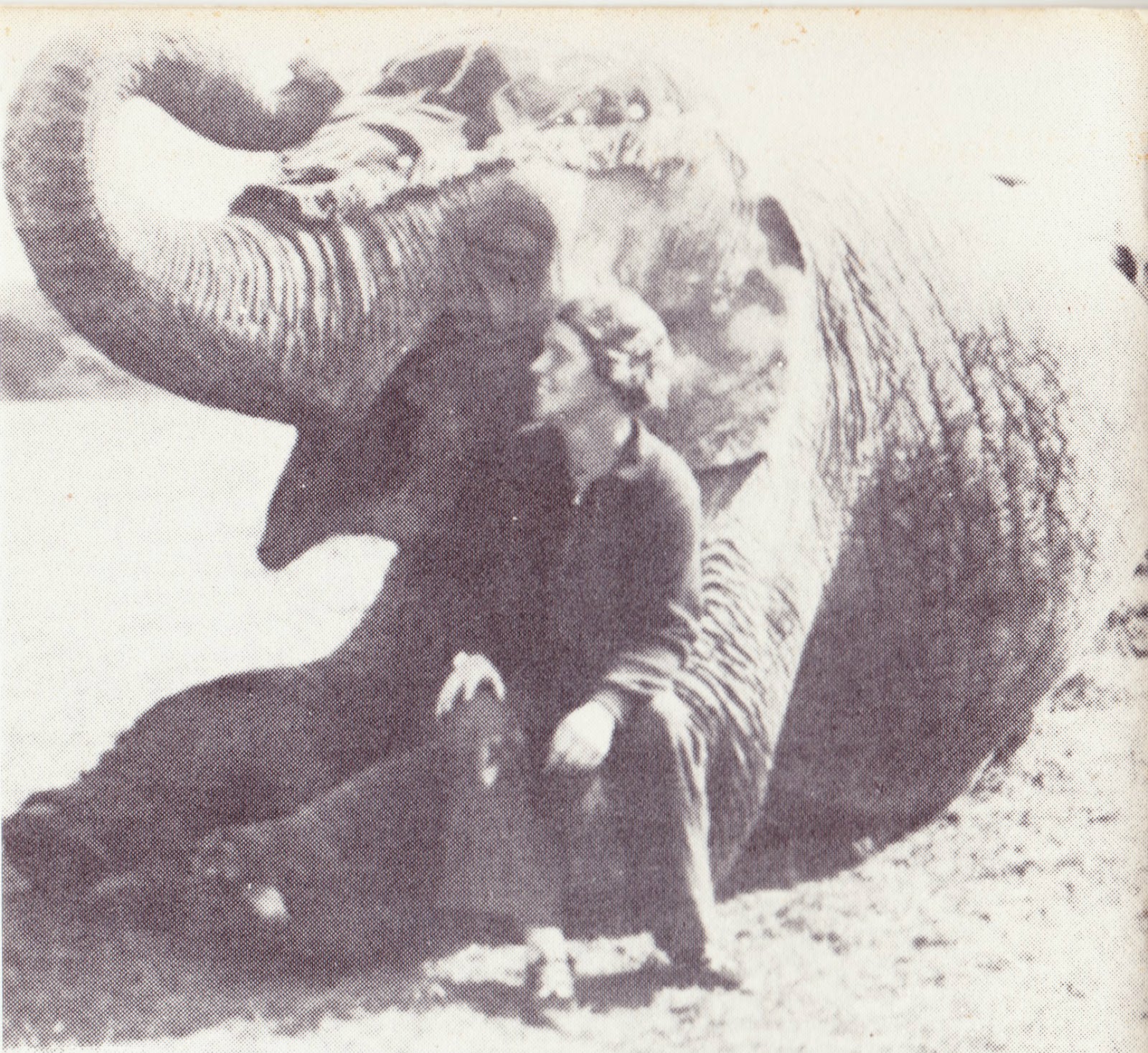
|
Ruth
Manning-Sanders:
Poet, writer, editor
Dr. Helga Kaschl
Ruth Vernon Manning-Sanders was a poet, novelist, collector and editor
of folk tales, fables, ballads, ghost and
fairy stories. She became known mainly for her
children's and young adult books, in which she retold stories from
around the world with great wit and humor.
Ruth was born in Swansea, Wales, in either 1886 or 1888 – the dates vary
– the youngest daughter of Emma (née Browne Brock) and John Edmondson
Manning, a Unitarian minister. Her understanding parents encouraged
their three daughters' independent thinking by giving them free access
to their large library; avid readers, the children soon began to write,
and together they composed and performed plays. Ruth enjoyed a very
happy childhood in Manchester, where the family moved in 1902, and often
spent her holidays in the Scottish Highlands at a farm called "Shian,"
meaning "the place where elves lived." Granny Stewart, the eldest of the
large farming family, told the children old folk tales and local
stories; on her tenth birthday, by chance, a man came by with a dancing
bear and, in return for an overnight stay, made it dance – perhaps the
beginning of Ruth's passion for the circus.
 After
graduating from school, she received a Shakespeare scholarship and began
studying English Literature and Drama at Manchester University; however,
due to illness and subsequent recovery stays in Italy and Devon, she
ended her studies early.
In Devon, she met the painter and later writer George Rawlings Sanders
(1884/5–1952) and married him on May 22, 1911, in Totnes. As an
expression of equality, Ruth Manning and George Sanders hyphenated their
surnames, each adding their partner's name, and literally walked their
path together: for two years, they traveled through Great Britain in a
horse-drawn wagon, working in the Circus Rosaire, owned by Fred and
Florence Ross (known as Count and Countess Rosaire). Ruth
Manning-Sanders processed her experiences and impressions, and her love
of the circus, in a series of non-fiction books, novels, and short
stories.
With the birth of their daughter Joan in 1913, their circus period came
to an end, and they moved to a cottage in Bude, Cornwall. However, their
penchant for a nomadic life must have persisted, as the family—grown by
the addition of their son David in 1915—lived from 1914 onwards in
Newlyn, Cornwall; Midhurst, Sussex; Catchall, Cornwall; Grasse near
Cannes; back to Catchall; and finally settled in Sennen Cove, Cornwall.
They soon came into contact with the people in their community, many of
whom were artists of the Newlyn School, and made their home a cultural
hub. In 1918, Walter de la Mare spent some time with the Manning-Sanders
in Sennen, and in 1932, the writer Mary Butts moved to Sennen and became
their neighbor. This year they had moved into "Esther's Field" in
Maria's Lane - above the bay - Mary Butts occupied "Sarah's Well", "Tebel
Vos" (today "Namaste") and then "No Place".
The children—Joan and David—had a governess, Florence Bridge, who
tutored them, recognized Joan's talent for drawing, and nurtured it.
Joan was so gifted that family friends—Father Bernard Walke and his
wife, the painter Annie Walke—commissioned her to paint six pictures for
St. Hilary's Church, pictures that—along with works by Roger Fry, Annie
Walke, and members of the Newlyn School—can still be seen today. Her
parents had a studio right by the sea where Joan could paint. At just
thirteen, she participated in an exhibition for young artists in London.
The requirement for participation was a minimum age of eighteen, and her
age of thirteen was mistakenly taken for eighteen. Her paintings caused
a sensation and were subsequently shown at the Royal Academy and in all
the major art exhibitions. She exhibited regularly at the Royal Academy
afterward, but in 1936 her paintings were returned because they did not
conform to the modern style. Joan then enrolled at Chelsea Art School,
met and married Roderick Floyd, a fellow student; the couple moved to
Paris, returned to Cornwall in 1940, had two sons—Christopher and John
Floyd—and emigrated to Canada in 1949. After that, Joan stopped
painting. Little is known of David Manning-Sanders' life; there are
drawings or paintings by his sister, for example, of him as a schoolboy
with a globe and as a young man; he probably died in the Second World
War.
George Manning-Sanders was confined to a wheelchair by a serious
illness, could no longer paint, and concentrated on writing: he
published three autobiographical novels ("Drum and Monkey," "The Burnt
Man," and "The Third Day") and a number of short stories; one of his
texts was included in "The Best British Stories" in 1925. He died in an
accident in 1952.
 After
her daughter returned from Canada – her husband had also passed away –
Ruth Manning-Sanders lived with Joan and her sons in "Esther's Field"
in Sennen; Joan helped with the research for her books, which she
tirelessly wrote and published well into old age: her last book, "A
Cauldron of Witches," was published six months before her hundredth
birthday.
Ruth Manning-Sanders was an extremely prolific writer who, at the
beginning of her career, mainly wrote poems and verse narratives, and
then switched to prose, narrative and non-fiction for adults and
children; in total she published about one hundred books, which were
repeatedly reprinted.
In a 1918 anthology, "Twelve Poets. A Miscellany of New Verse" (Selwyn
and Blount / archive.org), three of her poems were printed: "Song from
'Loki'," "Night," and "Age." The collection also included poems by W.H.
Davies, Vivian Locke Ellis, A. Hugh Fisher, Robin Flower, John Freeman,
James Guthrie, J.C. Squire, Rowland Thirlmere, Edward Thomas, W.J.
Turner, and Walter de la Mare, who encouraged her work. Both de la Mare
and Davies also published texts in *The Living Age * in December 1919,
and in the same year, Ruth Manning-Sanders' first collection of
thirty-four poems, "The Pedlar and Other Poems," was published .
In 1921, she sent a manuscript to the Hogarth Press, hoping for
publication. Virginia Woolf—"a new long poem by a little fat
poet"—decided to publish it; she described the author as "a woman with a
bobbed haircut, a wide mouth, in a velvet dressing gown, plump, auburn,
with wide-set brown dog eyes," rather shabby, shabby, and full of
compassion, sympathetic. In May 1922, the 43-page volume "Karn" appeared
in the Hogarth Press; it was bound in gold-colored cardboard, had a red
label with black printing, and a print run of 200 copies. "Karn," as
well as the subsequent collection of poems, did not sell particularly
well; "Martha Wish-You-Ill"—typeset by Virginia Woolf herself—appeared
in July 1926, bound in multicolored marbled paper with a cream-colored
label printed in black. The slim volume, only 16 pages long, had a print
run of 280 copies. Poems from the collection appeared in 1926 in
*Poetry* (Vol. 27, No. 5, Poetry Foundation, Chicago): Legend / Martha
Wish-You-Ill, Hands / Eleven Saved / Solitary Peaces. In August 1927
(Vol. 30, No. 5), *Poetry* published five of her poems under the title
"Monstrous Happenings" (Darkness / One Two Three and Four / Mr. Benny /
The Poultry Farm / Away); other contributions included works by Dorothy
Richardson and John Rodker, a friend of the Manning-Sanders family. Also
in 1927, the verse narrative "The City," dedicated to Virginia Woolf,
was published. One critic considered it one of the best written in the
previous thirty years, and it earned her the Blindman Poetry Prize, an
award from the Poetry Society of South Carolina that was discontinued.
After "The City," Ruth Manning-Sanders published no further poems.
After publishing "The Twelve Saints," an ironic look at an artists'
colony in Cornwall, in 1925, she followed this with books almost
annually, including "Waste Corner," a novel about English country life,
"Selina Pennaluna," "Hucca's Moor," "The Crochet Women"—a novel that
delighted her neighbor in Sennen, the writer Mary Butt—"The Growing
Trees," "She was Sofia," "Run Away," "Mermaid's Mirror," "The Girl Who
Made an Angel," "Children by the Sea," "Elephant: The Romance of Laura,"
"Luke's Circus"—dedicated to Flo and Fred Rosaire—and "Mystery of
Penwarth," a mysterious story for young people.
 In
the following years, Ruth Manning-Sanders worked primarily on
non-fiction books, publishing "The West of England" in 1949, a book with
old photographs and maps through which she wanted to convey her very
personal view of Cornwall, Devon, and Somerset. "The Swan of Denmark," a
captivating and affectionate biography of Hans Christian Andersen, with
illustrations of Andersen's life by Astrid Walford, also appeared in
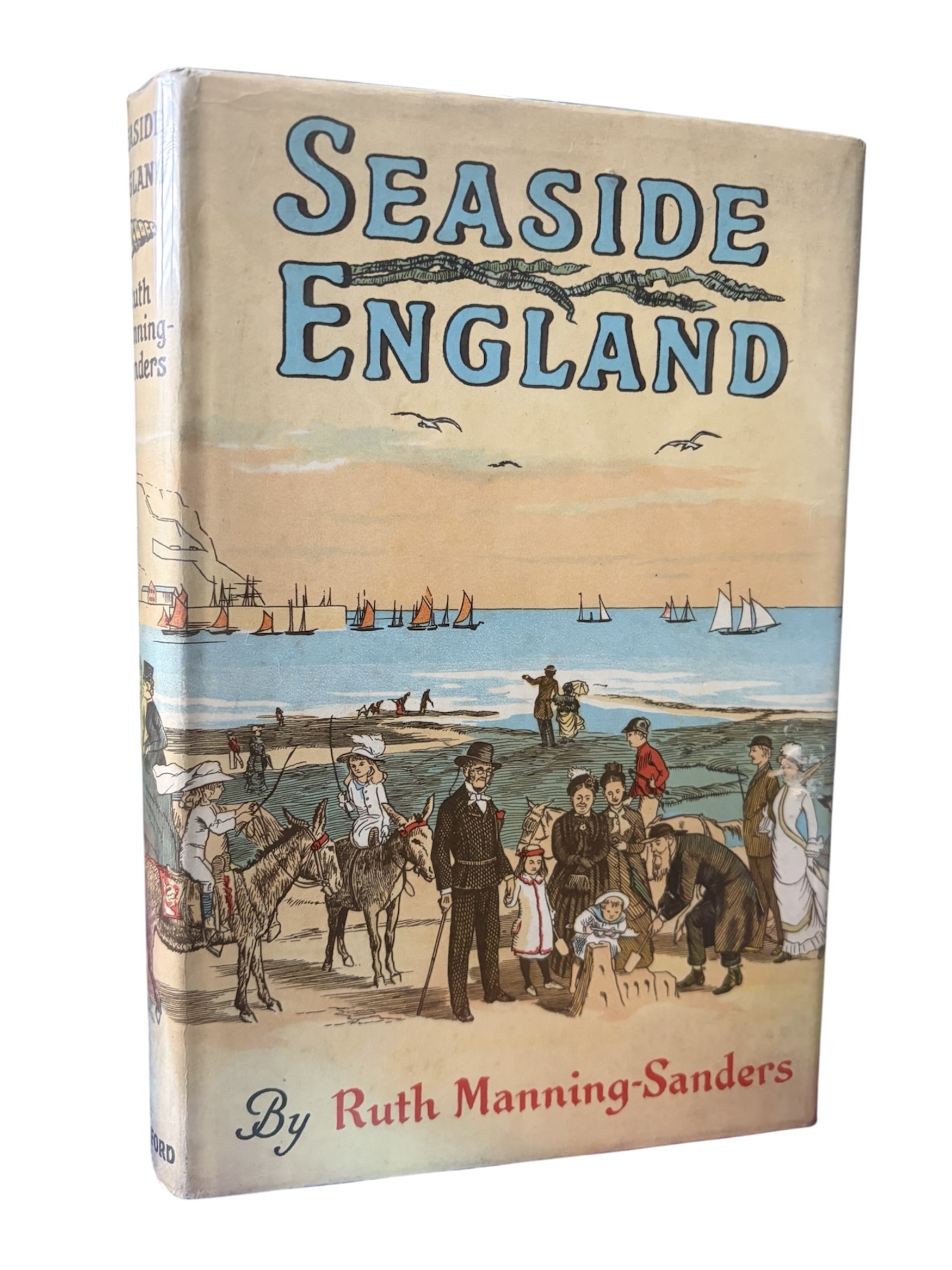
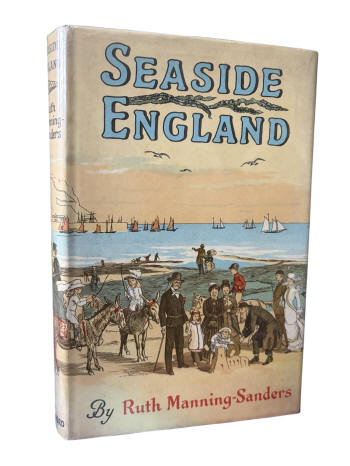
1949. In "Seaside England," she recounted the history and evolution of
seaside holidays, from the 17th century to the mid-20th century; the
cover features Randolph Caldecott's painting of Scarborough in 1818, and
the frontispiece a watercolor by J.M. Whistler. With "The River Dart,"
she wrote the first book about one of England's most beautiful rivers.
And her love for the circus, her experiences with Circus Rosaire, are
reflected in her book "The English Circus," a comprehensive history of
the circus in England, its great directors and artists, with chapters on
the various disciplines—from clowns to trapeze artists—as well as on the
animals and their trainers. The novel "The Golden Ball," published three
years later, again deals with the circus and draws parallels to the life
of the famous circus artist Leon LaRoche.
From the late 1950s onward, Ruth Manning-Sanders primarily wrote
children's and young adult books, collecting folk tales, fables,
ballads, ghost stories, and fairy tales from around the world, retelling
them, and publishing a large number of anthologies. Her first anthology,
"Peter and the Piskies," contains 34 Cornish fairy tales illustrated by
Raymond Briggs and was an enormous success. In "A Bundle of Ballads,"
she collected over sixty ballads and songs, rewriting them for
accessibility; William Stobbs received the Kate Greenaway Medal in 1959
for his illustrations. Over the next thirty years, more than twenty
anthologies appeared, featuring fairy tales and stories from around the
world, animal stories, poems about animals from Chaucer to Blake, circus
stories, holiday tales, and just as many novels and stories for young
adults, some with a historical backdrop, such as "The Smugglers," "The
Extraordinary Margaret Catchpole," and "The Spaniards are Coming!"
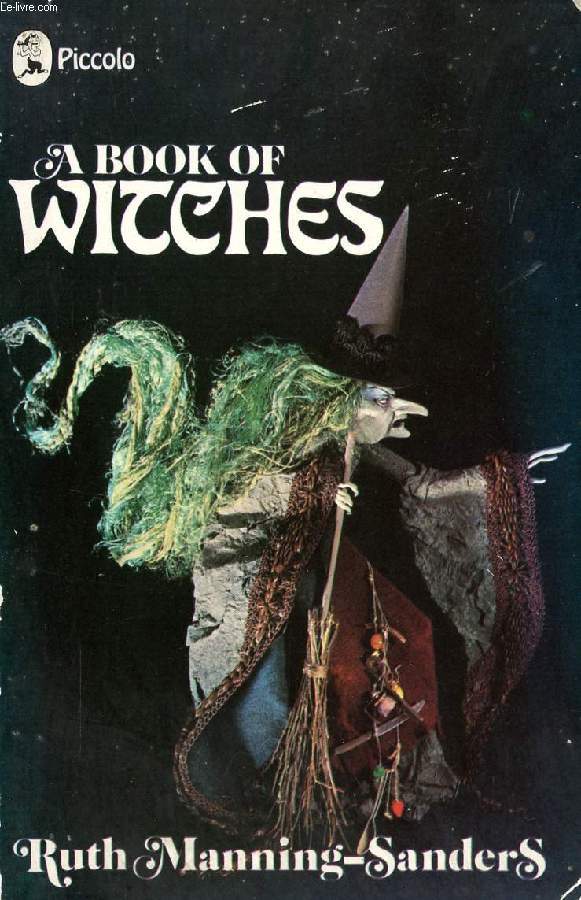
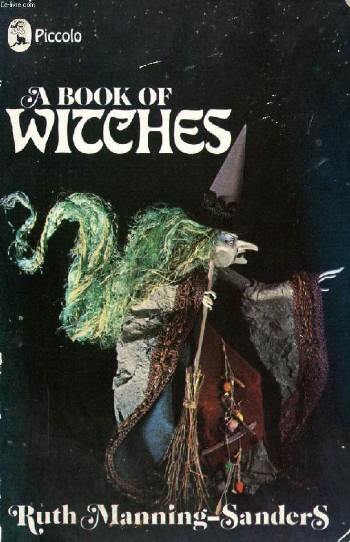
Ruth Manning-Sanders also became very popular with her series "A Book
of...", published by Methuen/Children's Books in twenty-three volumes.
The series began in 1962 with "A Book of Giants" and ended in 1988 with
"A Book of Magic Horses." In between were books about dwarves, dragons,
witches, wizards, mermaids, ghosts, princes, princesses, kings, queens,
and beings from magical worlds. The entire series was illustrated by
Robin Jacques, who greatly valued his collaboration with Ruth
Manning-Sanders on twenty-five books.
Besides Robin Jacques, other well-known artists illustrated her books;
these included Victor G. Ambrus, Scoular Anderson, Eileen Armitage,
Raymond Briggs, Donald Chaffin, Jo Chesterman, Brian Froud, Lynette
Hemmant, James Hodgson, Harold Jones, Annette MacArthur-Onslow,
Constance Marshal, Kilmeny Niland, William Papas, Rita Parsons, Trevor
Ridley, Jacqueline Rizvi, Mary Shepard, Leon Shtainmets, William Stobbs,
Astrid Walford and Jenny Williams.
Ruth Manning-Sanders:
August 21, 1886/88 – October 12, 1988
https://www.schreibfrauen.at/
Bibliography and list of sources:
J. Howard Woolmer: A Checklist of the Hogarth Press. 1917–1946. Woolmer/Brotherson
Ltd., Revere, Pennsylvania 1986
Virginia Woolf: Letters 1. 1888–1927. S. Fischer Verlag, Frankfurt am
Main 2006
Virginia Woolf: Diaries 2, 1920–1924, S. Fischer Verlag, Frankfurt am
Main 1994
Nathalie Blondel: Mary Butts. Scenes from the Life. McPherson & Company,
Kingston, New York 1998
Joan Manning Sanders. A Young Artist. With an introduction by Helen
Ferris. The Junior Literary Guild, New York 1931 (Archive.org)
Melissa Hardie (Ed.): 100 Years in Newlyn: Diary of a Gallery. Hypatia
Publications, 1995, p. 82 (Joan sends picture to RA)
William Murray: The English Circus, by Ruth Manning-Sanders. The
Saturday Review , April 3, 1954, p. 14
en.wikipedia.org/wiki/Ruth_Manning-Sanders
Oxford Dictionary of National Biography, Oxford University Press, 2004,
Veronica Hurst: Sanders, Ruth Vernon Manning- (oxfordnb.com/view/article/58989)
www.modernistarchives.com/person/ruth-manning-sanders
www.papergreat.com/search/label/Ruth%20Manning-Sanders
www.poetryfoundation.org/poetrymagazine/browse/27/5#!/20575390
www.wilson-history.co.uk/html/rosaire_family.html
cornwallartists.org/cornwall-artists/joan-manning-sanders
savependarvesquoitgiantswoods.weebly.com/natural-thinking.html
Ruth Manning-Sanders -
Publications (selection):
The Pedlar And Other
Poems. Selwyn & Blount, London 1919 / archive.org
Karn. Hogarth Press,
London 1922
Pages from the History
of Zachy Trenoy - Sometime Laborer in the Hundred of Penwith.
Christophers, London 1923
The Twelve Saints.
Christopher's, London 1925
Martha Wish-You-Ill.
Hogarth Press, London 1926
The City. Ernest Benn,
London 1927
Waste Corner.
Christopher's, London 1927
Selina Pennaluna.
Christopher's, London 1927
Hucca's Moor. Faber &
Gwyer, London 1929
The Crochet Woman.
Faber & Faber, London 1930
The Growing Trees.
Faber & Faber, London 1931
She was Sofia.
Cobden-Sanderson, London 1932
Run Away. Cassell &
Co., London 1934
Mermaid's Mirror.
Cassell & Co., London 1935
The Girl who Made an
Angel. Cassell & Co., London 1936
Children by the Sea.
Collins, London 1938
Elephant: The Romance
of Laura. Frederick A. Stokes Company, New York 1938
Luke's Circus. Collins,
London 1939
Mystery at Penmarth.
Illustration by Anne Bullen. Collins, London 1941
Circus: Book in Color
Photography. Drawings by Patric O'Keeffe, Photographs by John Hinde,
John Markham and W. Suschitzky. Collins, London 1947
The West of England. BT
Batsford, London 1949
Swan of Denmark: The
Story of Hans Christian Andersen. Heinemann, London 1949
Seaside England. BT
Batsford, London 1951
The River Dart.
Westaway Books, London 1951
The English Circus.
Laurie, London 1952
Mr. Portal's Little
Lions. Robert Hale, London 1952
The Golden Ball: A
Novel of the Circus. Robert Hale, London 1954
Melissa. Robert Hale,
London 1957
Peter and the Piskies:
Cornish Folk and Fairy Tales. Oxford University Press, London 1958
A Bundle of Ballads.
Oxford University Press, London 1959
Circus Boy. Oxford
University Press, London 1960
Red Indian Folk and
Fairy Tales. Oxford University Press, London 1960
Animal Stories. Oxford
University Press, London 1961
Birds, Beasts, and
Fishes. Oxford University Press, London 1962
The Smugglers. Oxford
University Press, London 1962
The Red King and the
Witch: Gypsy Folk and Fairy Tales. Oxford University Press, London 1964
Damian and the Dragon:
Modern Greek Folk Tales. Oxford University Press, London 1965
The Crow's Nest.
Antelope Books, Hamish Hamilton, London 1965
Slippery Shiney. Hamish
Hamilton, London 1965
The Extraordinary
Margaret Catchpole. Heinemann, London 1966
The Magic Squid.
Methuen, London 1968
Stories from the
English and Scottish Ballads. Heinemann, London 1968
The Glass Man and the
Golden Bird: Hungarian Folk and Fairy Tales. Oxford University Press,
London 1968
Jonnikin and the Flying
Basket: French Folk and Fairy Tales. Oxford University Press, London
1969
The Spaniards are
Coming! Heinemann, London 1969
Gianni and the Ogre.
Methuen, London 1970
A Choice of Magic.
Methuen, London 1971
The Three Witch
Maidens. Methuen, London 1972
festivals. Heineman,
London 1973
Stumpy: A Russian Tale.
Methuen, London 1974
Grandad and the Magic
Barrel. Methuen, London 1974
Old Dog Sirko: A
Ukrainian Tale. Methuen, London 1974
Sir Green Hat and the
Wizard. Methuen, London 1974
Tortoise Tales. Thomas
Nelson, USA 1974
Ram and Goat. Methuen,
London 1974
Young Gabby Goose.
Methuen, London 1975
Scottish Folk Tales.
Methuen, London 1976
Fox Tales. Methuen,
London 1976
The Town Mouse and the
Country Mouse: Aesop's Fable Retold. Angus & Robertson, London / Sydney
1977
Robin Hood and Little
John. Methuen, London 1977
Old Witch Boneleg.
Angus & Robertson, London / Sydney, 1978
The Cock and the Fox.
Angus & Robertson, London / Sydney 1978
Boastful Rabbit.
Methuen, London 1978
Folk and Fairy Tales.
Methuen, London 1978
The Haunted Castle.
Angus & Robertson, London / Sydney 1979
Robin Hood and the Gold
Arrow. Methuen, London 1979
Oh really, rabbit!
Methuen, London 1980
Hedgehog and Puppy Dog.
Methuen, London 1982
Tales of Magic and
Mystery. Methuen, London 1985
A Cauldron of Witches.
Methuen, London 1988
Methuen Children Books:
"A Book of ...." series:
A Book of Giants, 1962
A Book of Dwarfs, 1963
A Book of Dragons, 1964
A Book of Witches, 1965
A Book of Wizards, 1966
A Book of Mermaids,
1967
A Book of Ghosts and
Goblins, 1968
A Book of Princes and
Princesses, 1969
A Book of Magical
Beasts, 1970 (Editor)
A Book of Devils and
Demons, 1970
A Book of Charms and
Changelings, 1971
A Book of Ogres and
Trolls, 1972
A Book of Sorcerers and
Spells, 1973
A Book of Magic
Animals, 1974
A Book of Monsters,
1975
A Book of Enchantments
and Curses, 1977
A Book of Kings and
Queens, 1977
A Book of Marvels and
Magic, 1978
A Book of Spooks and
Specters, 1979
A Book of Cats and
Creatures, 1981
A Book of Heroes and
Heroines, 1982
A Book of Magic
Adventures, 1983
A Book of Magic Horses,
1984
|