|
Into the Breach
with Ken Turner
Martin Holman
It is rare for an artist in his 90s to get a spot at the annual
Glastonbury music festival.
Ken Turner, however, is not cast from a conventional mould. For decades,
the St Ives art pioneer has taken his art to his audience.
This summer, his handiwork was part of the festival’s Block9 area that
celebrates freedom of expression, diversity and protest with immersive
sound and art installations. His contribution was a Tesla electric car
that he had crushed by driving over the vehicle in a WW2-era Sherman
tank.
As part of Turner’s latest exhibition, which anticipates his 100th
birthday next summer, the Wharfside Art Hub in Penzance is showing the
short film of the momentous event (until 31 October).
Working with Led by Donkeys, the political campaign group that famously
lowered a banner reading “I crashed the economy” behind Liz Truss at a
public speaking event, the nonagenarian characteristically put his ideas
into spectacular action.
The war veteran donned fatigues and a helmet and slid into the tank
cockpit. Then his co-driver opened the throttle and advanced on the
unsuspecting Model 3.
Turner is a political artist. That is, he deals with social ideas. They
emerge from a personal conscience troubled by contemporary conflicts on
land and over the environment. Recent events on our planet have sadly
kept him busy.
The results make up this new show, which opened on Sunday with,
alongside the film, 17 large-scale paintings made this year alone.
Turner’s work expresses deeply-felt protest against violence and
destruction. For him, art is a way of living as a critical human being.
His instrument is not propaganda, an outdated language he believes that
is ultimately counter-productive. Instead, he uses forceful imagery to
encourage thought and discussion.
Rather than see graphic representations, viewers sense the physical
drama of life forms under immense duress, from war or the scarcity of
vital resources. Colour, form, gesture and material, the essence of
painting, generate the strong visual impact.
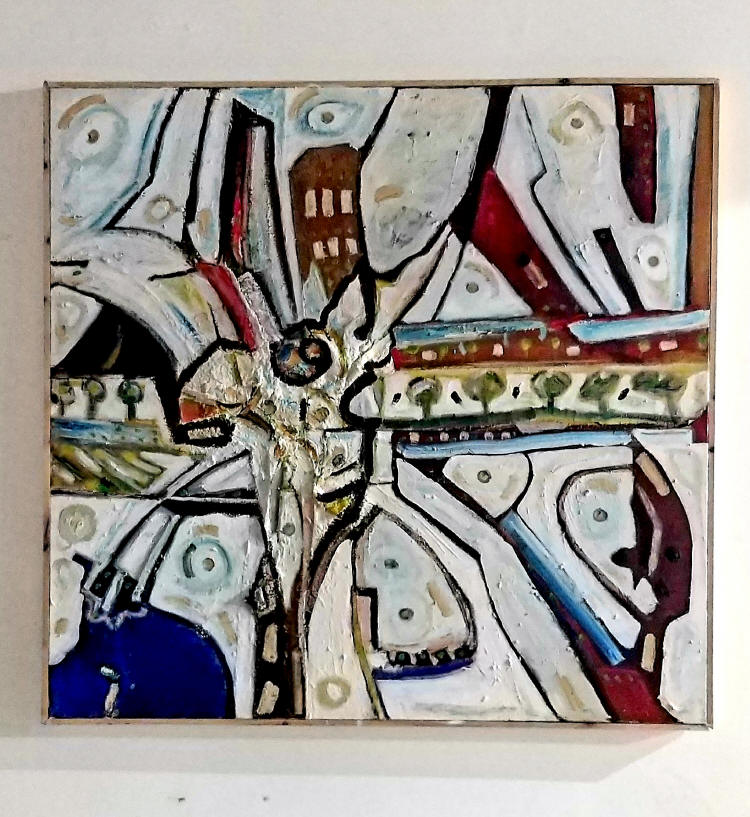
The composition of “Nature Crying Out” looks fragmented, as if the
ground has fissured in a disastrous cataclysm. At first the artwork
looks abstract. Clutches of diverse shapes, crusty with plaster, clash
and collide in low relief.
Turner applies a gypsum layer to raw canvas, handling the texture as if
in search of the picture. As the surface dries he introduces bold
acrylic colours that infuse edges with energy. Just as his images come
from a lifetime’s experiences, they also rely on a kind of conversation
with materials.
“I listen to what the paint tells me,” he says, adding that the reply
often points in directions he was not expecting. Nevertheless, he
follows. That engagement with making supplies the strength of his
painting. It communicates visually with the audiences and activates our
response.
Details appear, such as trees and buildings caught in the turmoil. Is
the scene falling inward or exploding beyond its frame? “Feelings are
very important,” he says. “If you have strong ideas, you have an
empathy, a deep sense of emotional intelligence.”
Inevitably, the plight of displaced communities in the Middle East is
also a subject, provoking his most ardent images.
Turner has no time for the profit-driven priorities of today’s
authoritarian leaders, whether of nations or global enterprises. His
focus is altruistic, highlighting global perspectives he believes
humanity should be concerned with. His career has always dealt with big
themes, often on a big scale.
As painter, performer, organiser and provocateur, Turner has animated
audiences from London’s ICA to the Edinburgh Festival during his long
career.
Inspired by experimental theatre and legendary director Joan Littlewood
in the 1960s, he broke traditional boundaries to bring visual artists
and public together.
He masterminded temporary installations of huge inflatable structures.
Set up in parks and city squares, they were sites for spontaneous
discovery and performance. Visitors were immersed in flexed and cambered
interior spaces that triggered the imagination.
Shaped by profound ideas, the projects helped change the popular
perception of art by emphasising partnership in creativity.Art could be
simultaneously fun, popular and serious.
Returning to painting, Turner settled in West Cornwall in 1993. Always a
campaigner, his weapon is thought through articulate imagery rather than
overbearing slogans. At 99, neither his energy nor his commitment to the
power of painting have diminished.
see
https://www.artcornwall.org/interviews/Ken_Turner.htm
for interview from 2009 |

