|
|
| home | exhibitions | interviews | features | profiles | webprojects | archive |
|
The
Poetic Energy of
Liliane Lijn
at Tate St
Ives
Martin Holman
We are surrounded by technology, so it is not surprising that
motorised movement found its way into art.
Artists have been incorporating motion into art since early last
century. A pioneer was the Russian emigré sculptor and theorist Naum
Gabo, who during WW2, lived and worked in St Ives.
Then 'art that moves' became a major phenomenon in the 1960s,
and the term
'kinetic art' began to be widely used.
Liliane Lijn has been interested in how movement in art objects can
express the fluidity of our experiences of the worlds around us – the
outer world of reality and the world of inner being. Lijn is regarded as one of the leading experimental artists in Britain
and a strong voice for the feminist perspective in contemporary art. A
major exhibition at Tate St Ives surveys
her daring and visually exhilarating work.
For this artist, movement for the sake of it was never the point. Art
reflects the world we occupy and delves deeply into the rhythms and
properties that underlie existence.
In the early 1960s, words were everywhere. They clashed on crowded
streets, in advertising and on radio and television. Today, the rapid
turnover of images crowds our attention and, as a result, people live in a hubbub of one kind of language or
another.
This artist’s own life has been full of movement and temporal shifts.
Born in New York, she lived in Paris and Athens in her 20s and mixed
with the European art avantgarde – writers and musicians as well as
fellow artists. Then she settled in London, which has remained her base for 60 years.
Moreover, she soon began to work with engineers and scientists, whom
she saw as natural collaborators with her objectives. A pioneer of the transformation of scientific thought
into art, in 2005
she was resident artist with the NASA Leonardo project in California.
In a sense, her focus has always been on the future as much as the
present.
We expect art to be stable and static. As viewers, we move around or
look from new angles. Usually the image or object stays still. With Lijn, that relationship
alters into constant mobility.
Light has the role of bringing the invisible into sight. Lijn uses lenses and prisms to split light into its constituent colours and to set up reflections that stretch the space her work occupies. Like so much about her outlook, light is also a metaphor for looking into the unconscious, the drives that make us human. Similarly, she regards words as a material as physical and changeable as the metal, resins and plastic she constructs with.
Energy flows through this show, both as electricity and as thought.
And energy is the first stage in any causal chain: it is like
observing an idea or action unfold, or a living organism evolve into
new forms. Lijn’s art highlights this potentiality. Her
"Linear Light Column" (1969), a tall, slender cylinder with copper
wire tightly coiled around its length, resembles a generator – and a
figure in the most pared down, elemental shape.
As the column rotates, light reflects on the pattern notched in the
wire. Perhaps that linear pattern is a code, itself a type of
language, that only the light interprets.
Connections with technology keep cropping up. And overtones of sci-fi
stalk the upright sculptures like the backward arching, twinned
structure “Gemini” (1984).
Standing directly on the gallery floor for visitors to walk between,
they have slim, staff-like profiles. Prisms at the top project light
onto walls and people, bringing them together.
This part of the show is like stepping into the ritual place of a lost
– or futuristic – culture. Sculptures appear clothed in different
textures, such as feathers, wire, glass beads, minerals and coloured
fibres.
The drama implicit in her work from the start reaches a peak with
“Electric Bride” (1989). While not abandoning her abstract, formal
style, it adds a parallel approach that uses shapes that relate more
closely to the human body as a source of moral and physical energy.
Emotion is added to the atmosphere as well as the invitation to device
narratives about what we see.
This captivating piece is placed in a dark chamber. Inside is a
startling caged creation, taller than the people drawn in by its sound
and pulsing light. Red-hot wires connect the form with the grilled enclosure, feeding
electricity through the piece a torment.
A strobe light pulses from the top and words circulate as a whispered
melodic refrain around the stifling interior.
In Cornwall, our surroundings are populated by standing stones and
other ancient remains. With the original purpose muted by time, Myths
have been attached to them that speculate on their meaning. Lijn
reminds us that their influence continues into our advanced, digital
era. That explains why this show drawing on so many facets of our
perception feels at home in St Ives.
A second dark enclosure contains another spectacular encounter. Two
statuesque computerised forms stand side by side and seem to
communicate with each other with light and sound. Called “Conjunction of Opposites” (1986), they resemble two
power-dressers. But they are not depictions of specific people, but
active symbols of life forces.
A recorded six-minute monologue relates the story of a woman hardened
in battle with a lover. Embedded in opened, wing-like flanks are LED lights that flare in
black, yellow and red, the colours of danger and fear.
Fusions of industry and nature, they imply a strong and protective
presence that extends across time, from remote history to the distant
future.
That presence is feminine. Perhaps the sculptures recall goddesses or
warriors seen represented in different cultures to our own, just as
her earlier cones refer to Zen Buddhist meditation.
A revelation of this exhibition is to think of fundamental properties,
like energy and movement, in terms of gender. Lijn effectively
empowers our idea of the feminine by creating these bold, perceptually
fluid allegories. Lijn wants her art to highlight women’s experience in modern societies
where unequal relationships between men and women were still accepted.
The art world of Paris and London as Lijn developed her career was
dominated by men. It was common for a woman artist to be ignored.
Gradually, over 60 years, the attitude has changed, in large part due
to artists like Lililane Lijn.
This artist’s creativity remains undimmed by time. Lijn
puts us in touch with a universe of possibilities and her London
practice continues to thrive. The
originator of several ambitious public commissions, carried out on a
large scale, examples such as "Temenos" (2021) are ample proof. Part
of the development behind King's Cross station, this work is
conceptually taut.
Based upon the mathematics and interconnecting geometry of the circle,
steel poles rise from a base ring, gently twisting upwards to an apex
over 11 metres above. The open-framed structure, illuminated by LEDs,
retains the lucidity of the drawing it sprung from.
The only pity about this show is that it does not follow Lijn's path of inventiveness up to the present moment. Very little in the selection comes from the current century, a curatorial decision that is hard to understand, because it gives the misleading impression that the artist has hung up her charging cables. Nothing could be farther from reality. The show's subtitle "Arise Alive" is aptly applied to Lijn as well as her work. It arrives at Tate St Ives after earlier showings at Haus der Kunst in Munich and Vienna's mumok, home of the Ludwig Collection. The accompanying catalogue suggests that a different attitude to the show's range was adopted on both occasions.
Yet, if taken as a pause rather
than a premature end point in what claims to be a retrospective,
this curious act on the show's British outing whets the appetite for
more from a fascinating figure who continues to thrive among us.
“Liliane Lijn: Arise Alive”
continues at Tate St Ives until 2 November 2025
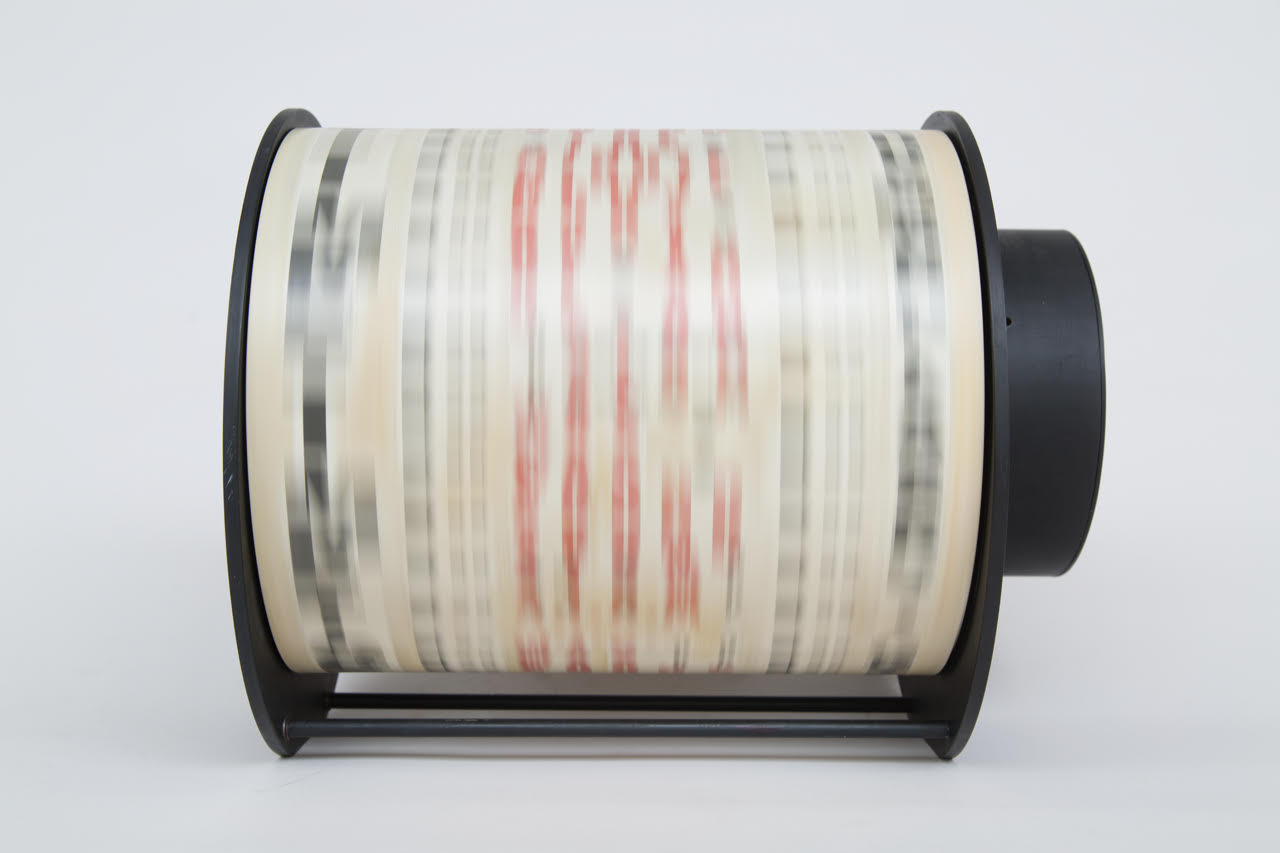
Top image: Liliane Lijn, Get Rid of
Government Time, 1962. Stephen Weiss, London
© DACS/Artimages, London. Photograph Richard Wilding
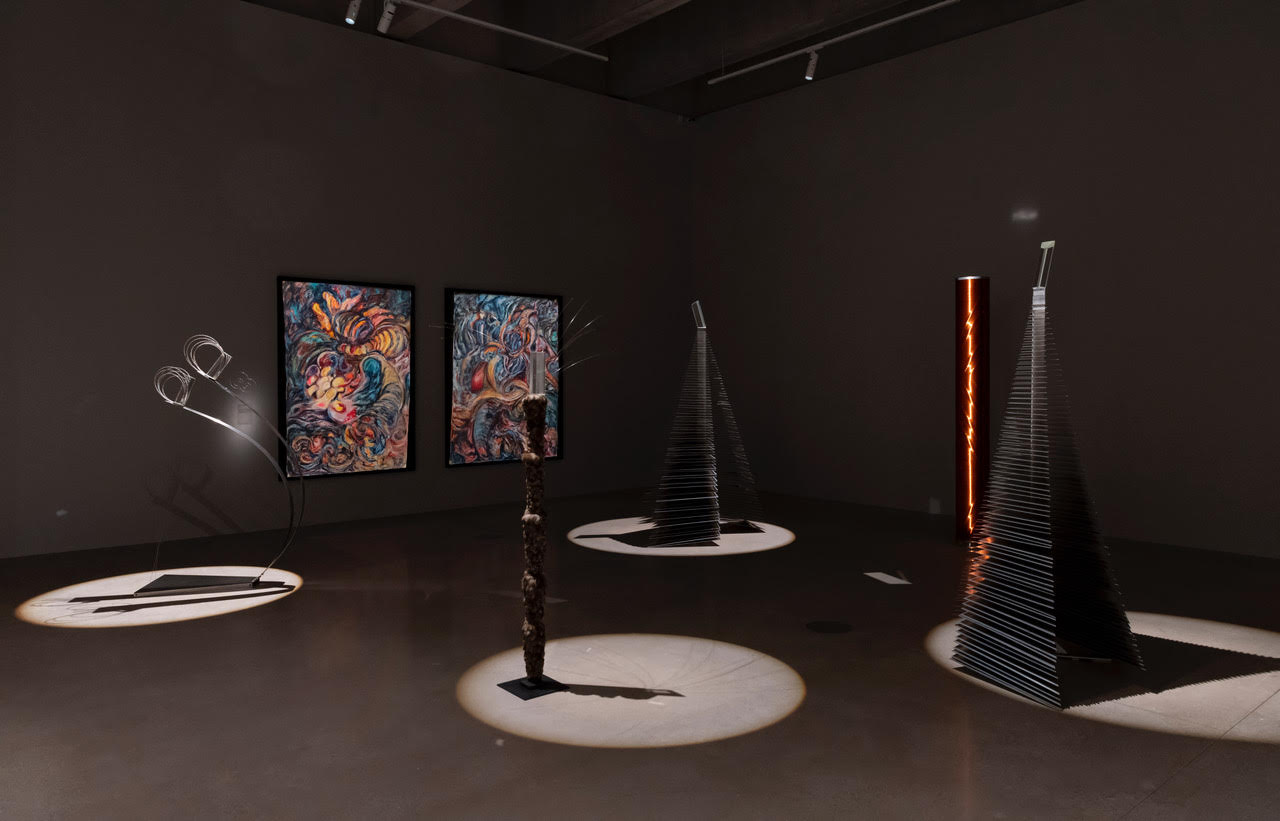
Bottom image: Liliane Lijn: Arise Alive exhibition view,Tate St Ives 2025.Courtesy of the artist and Sylvia Kouvali,London / Piraeus.Photo ©Tate (Oliver Cowling) |
|
|