|
|
| home | exhibitions | interviews | features | profiles | webprojects | archive |
|
Water dissolving and water removing
A Response to Alice Mahoney's 'Water Bodies' by Mollie Goldstrom
To view the chevron stone set in the parish church of Camborne’s west wall, one must carefully manoeuvre behind a freestanding office display board pinned with church notices printed on A4. The zigzagging panels recall the meander of fretwork above a Norman archway— a remnant of 12th century ornamental moulding set in 15th century granite masonry. Like the rood screens banned during the Reformation, the garish blue display forms a physical if not symbolic barrier concealing the stone from view. A fragment of proto-orthography, the chevron is a glyphic V isolated from the legibility that pattern and repetition bestow. Its single note harmonises with the heraldic ordinaries of Pendarves family genealogy, coats of arms rendered in stained glass, luminous even on a grey morning in which innumerable droplets of water hang and drift in still September air.
VVVVVVVVVVVVVVVVVVVVVVVVVVVVVVVVVVVVVVVVVVVVVVVVVVVVVVVV
Fragments of the stone’s far more ancient analogues call back in resonant harmony from behind a long glass case in Helston’s Museum of Cornish Life. Nestled amongst the laminate sheen of diminutive informational placards, potsherds of coarse gabbroic clay form a jumbled typography of chevrons— scored and imprinted signatures marked by cord, shell, and fingernail into the pot’s pre-fired surface. The collected remnants of briquetage vessels from a Romano-British saltworks on the Lizard peninsula are an object-lesson in how to remake one element of a coastal landscape as a tool to process another: raw material from the land rendered as vessels to evaporate the sea, water boiling away and leaving behind its salt.
Every baptism dating back to 1591 is recorded and preserved in the voluminous parish registers of St. Martin and St Meriadoc’s Church. The cool liquid shock of total immersion in holy water and the sharp mineral taste of salt would have marked the corresponding sensory impressions of an infant baptised in the Middle Ages. The granite font which the first-time visitor pauses before is a 19th century replacement and the corresponding doorway meant for the devil to exit by, having been driven out by the enaction of this, is now sealed. The visitor wonders: Where is the mermaid? Parking by the Aldi across the road there is but 90 minutes in which to find her before the merciless judgement of ParkingEye’s ANPR system is activated. A perfunctory circumambulation of the church’s interior is unlikely to yield an immediate answer. Observed in this initial circuit, the undulant glow of two brass chandeliers suspended overhead, treasures carefully dismantled annually and polished to a high shine by volunteer congregants. Hand-stitched banners in bright calicos proclaim: “Prayer is like a telephone/Call Anytime” and “For I know the plans I have for you/Trust me.” There is a security camera mounted on a central pillar which, godlike, watches and records.
Beunans Meriasek, one of two known 16th century Cornish stage plays chronicling a saint’s life, dramatizes his entrance into Camborne. Weary from the lengthy journey from Brittany over land and sea, St. Meriasek arrives with a great thirst. In search of a ready source of water, he finds his new surroundings wanting:
North-east of the chapel here I will go to wander, Water for me surely to seek
Kneeling in prayer in a nearby meadow, Meriasek strikes a rock from which a spring flows forth. There is scant description of this moment beyond the parenthetical stage note: Here the well springeth up water. What occurs in this instance is left largely to the imagination. The waters are charged with a power to heal all manner of physical and mental malady, curing the ailing parishioners of their every ill and uniting them both to one another and to the land itself by the solvent properties of water, be it imbibed or besprinkled.
From an industrialist’s perspective, a healing spring has potential significance beyond the consecrative blessing of a saint or sacred manifestation within an animist landscape. William Pryce, who painstakingly chronicled both the Cornish language and the particulars of Cornish mining in the 18th century observes:
The consideration of the nature of mineral spaws and springs, will sensibly inform us, that there is such a continual percolation of Minerals and Metals, or their salts or principles, through the pores and channels of the earth; and the goodness and providence of God are paternally apparent in their salubrious effects upon the impaired constitutions of mankind.
Pryce’s Mineralogia Cornubiensis is not only rich in descriptive detail of Cornwall’s geologic landscape, the formation and composition of its ores and minerals, and the various industrial processes used to extract and process them, it also offers instructions for locating these subterranean lodes and underground water systems using the ancient and occult art of dowsing:
The rod is attracted by all the Metals, by Coals, Bones, Limestone, and Springs of Water, with different degrees of strength in the following order: 1 Gold, 2 Copper, 3 Iron, 4 Silver, 5 Tin, 6 Lead, 7 Coals, 8 Limestone and Springs of Water.One method to determine the different attractions of the rod, is this: Stand, holding the rod, with one foot advanced; put a guinea under that foot, and a halfpenny under the other, and the rod will be drawn down […]
A circuit is a closed loop allowing for the transmission of signals and electrical currents in a complete revolution; an earth return uses the terrestrial surface as a conductor. A conductive array conjoining animal, vegetable, mineral, metal, earth, water, air, might the act of dowsing be understood as the speculative formation of a battery cell?
Upon a second survey of the church perimeter aided by a helpful church docent, the mermaid is located along the wall of the main sanctuary. Viewing her requires moving the heavy oaken sedilia, a three-seated bench piled with prayerbooks and a colourful cross-stitched kneeler— a considerable effort, even with two sets of arms lifting and gently lowering it on the dusty red carpeting. Crouching close to the floor, behind the canted angle of the bench, a bestiary in low relief ramps across the fine-grained oak panelling. Chimeras— a winged horse, a fecund figure with a foliate head and ruminant’s legs, a griffin, a harp-bearing fish-tailed woman, her countenance serene through a Reformation-induced defacement by chisel. Within the fabric of the church, these pre-Christian symbols of fertility and female sexuality hide in plain sight. Reconfigured from a 15th century pew, they exemplify the ever-shifting meanings and placements of objects within the church, a sedimentary accretion and layering that connects human activity to geological process.
How is a body of water misplaced? The exact site of St. Meriadoc’s holy well, a short distance from the church, is apocryphal. Its waters are thought to have been drained by nearby mine workings in the 19th century, its imprint covered by paved road or concealed on privately owned land— inaccessible to the contemporary seeker wishing to be brought back to their wits again, wishing to be made a true parishioner by its lost waters.
25/09/2026
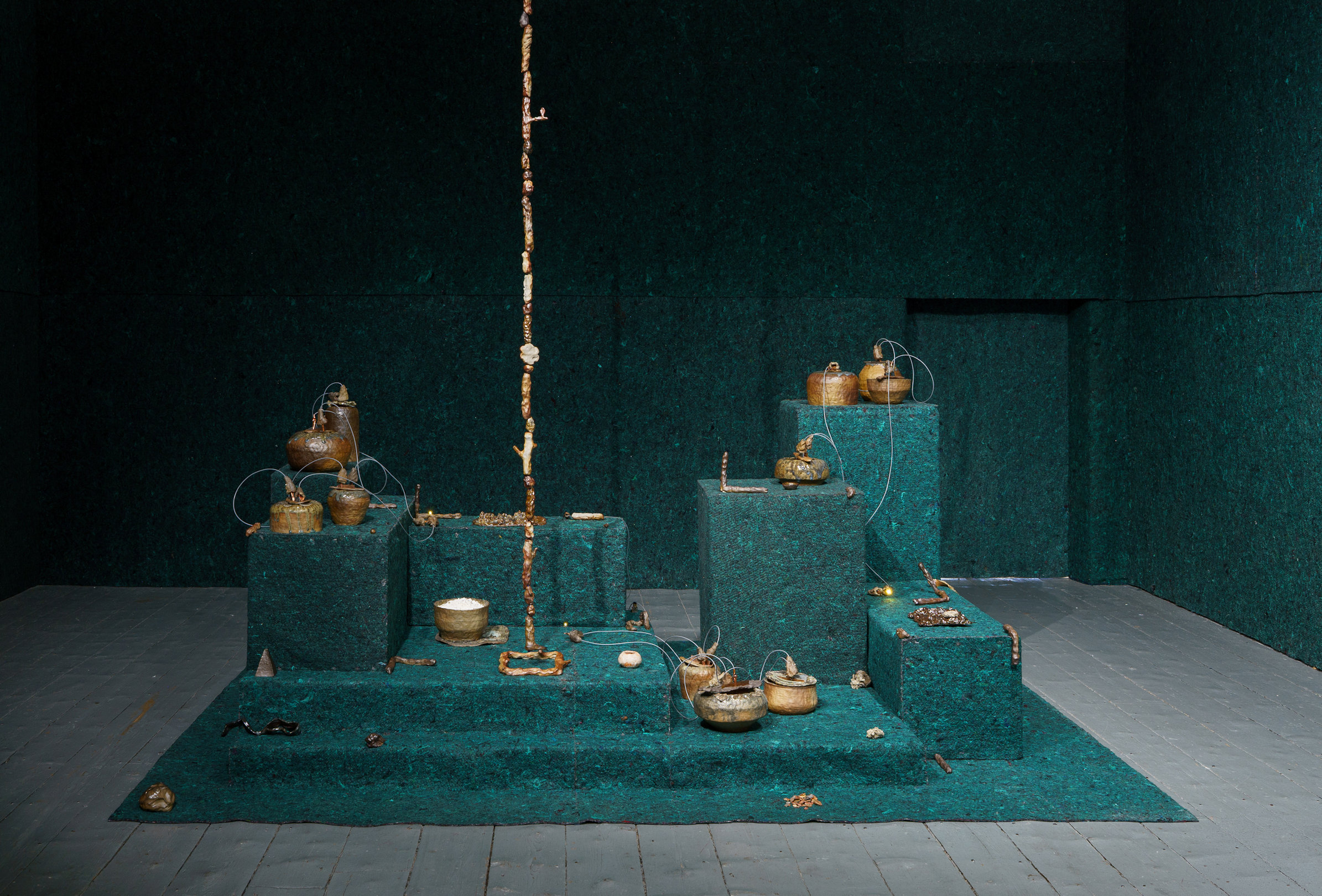
Alice Mahoney 'Water Bodies' was at Auction House, The Buttermarket, Station Hill, Redruth 25/09/26-18/10/26. See 'exhibitions' for installation shots.
|
|
|