|
|
| home | exhibitions | interviews | features | profiles | webprojects | archive |
|
A Walking Flame: Selected Magical Writings of Ithell Colquhoun Richard Shillitoe
I suspect that for most people Colquhoun’s legacy will principally lie in her paintings, especially the works of the 1940s when her visual imagination was perfectly allied to her use of automatism. That is, techniques of painting which enabled her to surrender all reason and conscious control in favour of the unconscious mind or extra-personal influences. But those seeking a more rounded perspective and an appreciation of how Colquhoun’s art was so closely related to her personal beliefs will need to turn to her writings. They will find that this book is an excellent point of departure. Its great value is not simply that it gathers together a large body of generally inaccessible material, but also that the writings reveal the underlying convictions that connected Colquhoun’s wide-ranging interests. In the essays we also catch sight of an unconventional mind caught between empirical observation and occult intuition, intellectual rigour and credulity, modernity and a search for an older sacred order.
Hale’s starting point for this book is that Ithell Colquhoun (1906-88), in addition to being an artist, writer and poet was also – perhaps primarily - the most consequential, creative and committed female occultist of the twentieth century. As evidence in favour of this proposition, she submits the forty-six individual pieces that make up the substance of this volume. Arriving less than a year after the Tate’s large retrospective of her artwork, it is, in essence, a retrospective of Colquhoun’s writings on magical themes. It journeys from the first essay, published when she was twenty-two years of age and still a student at the Slade School of Art in London to the last which appeared in 1979 nine years before her death aged eighty two. The book also contains Hale’s own substantial introduction, explanatory notes for each piece and sixteen pages of coloured illustrations which also come with editorial comments. The survey is a mix of articles that were published during Colquhoun’s lifetime and unpublished writings that were found among the papers she bequeathed to the Tate Archives. It is the most comprehensive compilation that is likely to appear, and it is immensely helpful to have them all in one place. Many will be new to readers because even those works that were published appeared mainly in short-lived specialist magazines with relatively small and committed readerships, and, therefore, had limited influence outside of subscribers. Hale, however, offers a corrective to this conventional viewpoint as she is at pains to point out that such magazines probably had a greater penetration than they are often credited with. She argues that they had an important role in legitimising the occult as a field of study. In agreement with other recent scholars Hale emphasises the importance of writers on the occult (particularly women) in reformulating ideas on imperialism, social reform and the desire to build a wider social movement based on spiritual progress. Wherever the final balance falls, it is certainly the case that, for Colquhoun, magic had a public facing as well as a private aspect. Of Colquhoun’s essays on magic perhaps those with the widest contemporary readership were those published in Prediction. This was a long-lived popular magazine, widely available on news-stands, in which articles on clairvoyance and graphology rubbed shoulders with ones on tarot reading, divination and parapsychology, all followed by pages of advertisements for mediums, tarot readers, palmists and casters of horoscopes. Colquhoun’s must have been amongst the most highly technical they ever carried and would have bemused the casual searcher after enlightenment in a teacup. At any rate, the scope and variety of Colquhoun’s magical writings remained largely unknown until her archive was catalogued and made publicly available in 2005. Since then, there have been several attempts to draw up a definitive bibliography, but each one has been quickly overtaken by further discoveries. There may be more still to be unearthed but the most comprehensive bibliography currently available is the online version at https://www.ithellcolquhoun.co.uk/bibliography.htm. As might be expected of a volume spanning a lifetime of thought and research, Colquhoun’s interests and preoccupations changed over the years. In contrast, her writing style did not. Hale is frank about her limitations although I think this matters less in the short essay format than in her imaginative fiction. Apart from the occasional foray into the florid and the polemical (Waterstone of the Wise p.77) the writing is clear and functional. Once her specialised vocabulary—often necessary when discussing technical aspects of magic—has been mastered, her writing presents few difficulties of comprehension. Her only stylistic quirk, apart from her sometimes unusual spelling, is a tendency to pose rhetorical questions which she then proceeds to answer herself.
Colquhoun’s painting style underwent continual development and it is difficult to believe that the Slade trained artist of the 30s was the same person who produced the constructions and collages of the 70s. It is interesting to ask whether Colquhoun’s magical beliefs developed over the years. One difficulty in providing a satisfactory answer is dating the texts. For example, The Night Side of Nature (p.81) had been composed by 1944 but was not published until 1954. The Openings of the Body (p.87) had an even longer wait: it was published in 1970, having been rejected twenty years earlier, in 1950. Many were probably worked on and revised in the intervening period. The chronological uncertainty makes it difficult to distinguish changes in Colquhoun's beliefs from changes in what she chose to – or what was able to -publish. What is clear is that during her lifetime the locus of her interests broadened. She became more interested in contemporary manifestations of spirituality rather than more established ones. She was, for example, increasingly drawn to the native British tradition, primarily in the form of Druidry, and to Celtic spirituality as explored by Yeats. Relevant pieces in the book include Wisdom Tradition of the Gael (1970) and Druidry (c.1975). Pilgrimage (1979) shows a foray into earth energies and New Age thinking. In this regard we do well to remember that she was the first to describe the Michael line in print (in her book The Living Stones, 1957) a full twelve years before John Michell published The View Over Atlantis. In some of the late essays the germ of ecofeminism starts to sprout. Hale’s short introductory notes to each piece are clear and authoritative. They supply the context and basic information from which a deeper understanding can emerge. Inevitably one would frequently like extra and one senses that Hale herself is itching to say more. Let me help her. For example, Hale asks, but doesn’t pursue, the question of why did the dream that inspired the short text The Order of the Sun and the Moon, Nicaragua (p.203) exert such a strong influence over Colquhoun for decades? And what on earth has the Nicaraguan activist, human rights advocate and former jet-setting actress Bianca Jagger got to do with it? Well, regarding the latter, the sanctuary where the chemical nuptials of the sun and moon were celebrated was a grotto in Nicaragua. Bianca means white – so perhaps her name was a coded reference to the lunar aspect of the Order and she was a secret initiate? And as for why the dream held such a lasting power over Colquhoun, my proposal – for which I have not the slightest shred of supportive evidence - is that she was remembering that the enormously influential Theosophical Society grew from Helena Blavatsky receiving spirit messages from the Secret Masters, a group of hidden adepts in Tibet. Colquhoun must have thought that if enlightenment could originate in Tibet, why not in Nicaragua? If it could be revealed to Helena Petrovna Blavatsky, why not to Margaret Ithell Colquhoun? Perhaps Colquhoun hoped that she too was on the verge of founding something as momentous as the TS, but, if I am right, it was another false dawn, not a golden one.
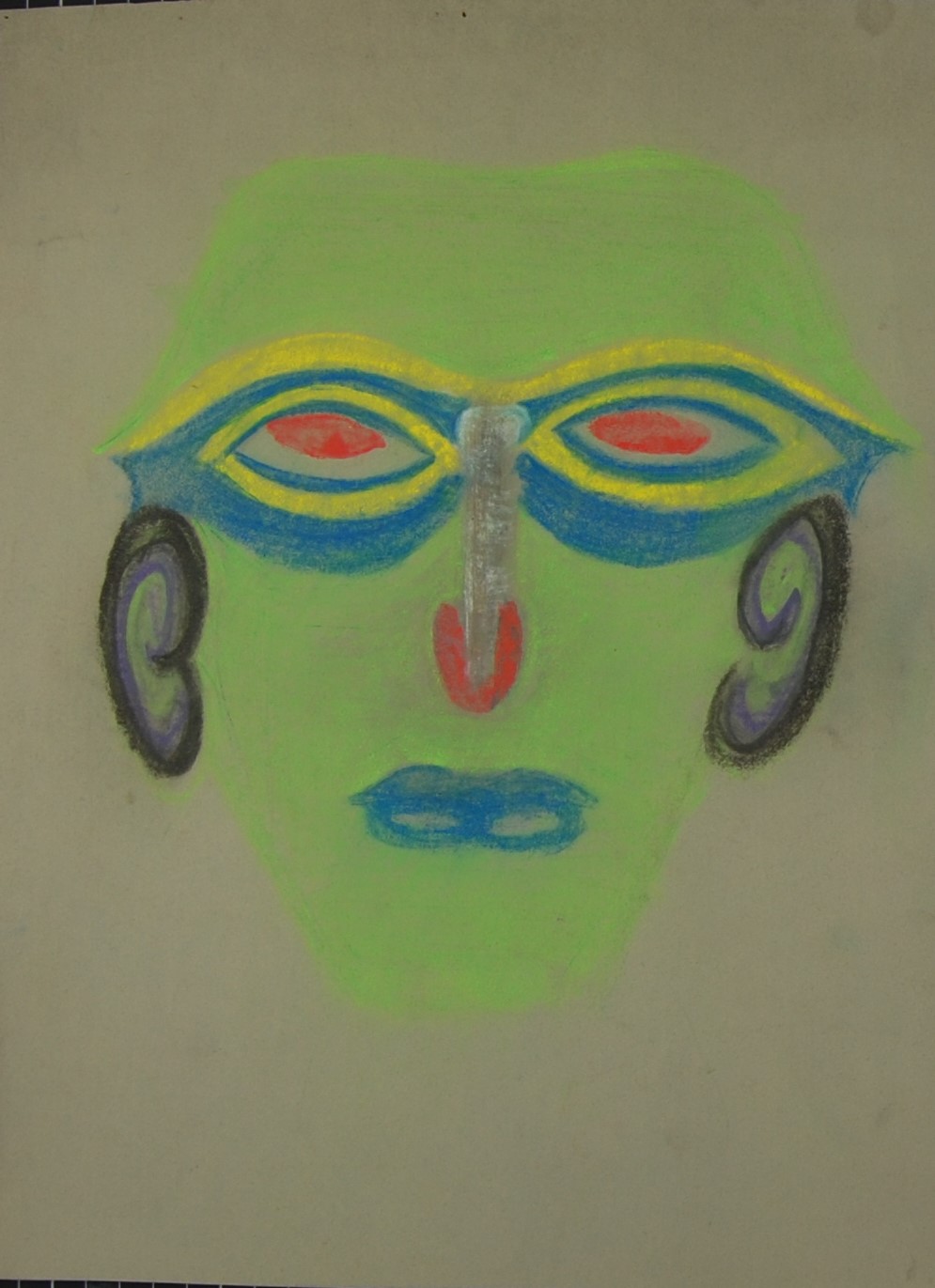
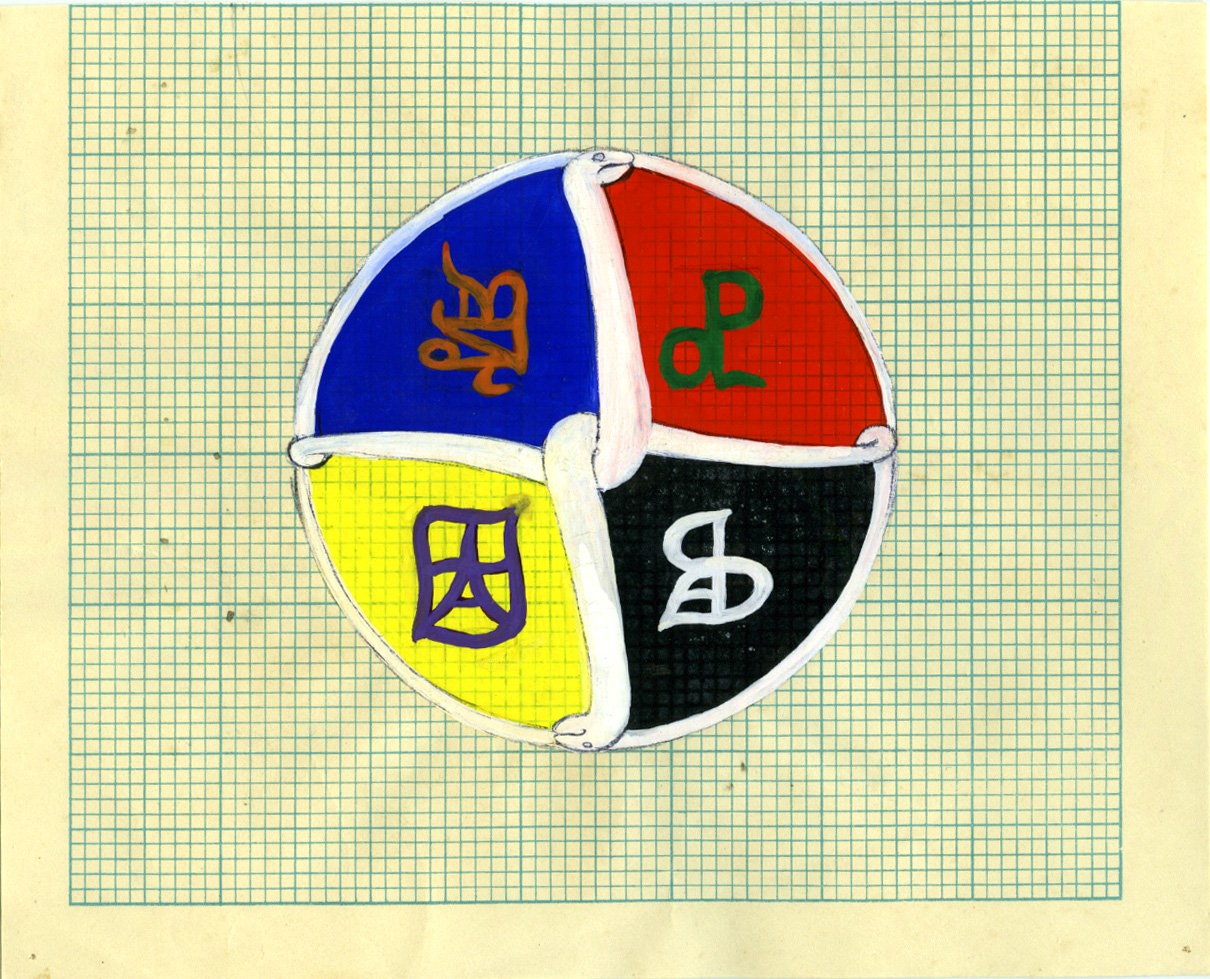
Hale’s title, A Walking Flame, comes from W.B. Yeats’ description of the occultist MacGregor Mathers in full Highland garb wearing several knives in his stocking, reporting how he remarked that when dressed in his kilt he “felt like a walking flame.” It is a title Colquhoun considered using herself for a projected autobiography. The project was never completed, although fragments were included in Sword of Wisdom. This is a book which is, as Hale points out, essentially a collage; part biography of Mathers, part Golden Dawn history, part an account of Colquhoun’s own spiritual development and part tangentially connected essays. Alone of all Colquhoun’s full-length books, Sword of Wisdom has never been republished in English. Aspects of it have been criticised in the internecine wars that inevitably seem to accompany all occult endeavours, but it contains much of interest. I can understand why Hale chose to publish the three free standing sections of the book that deal with Enochiana, Tantra and Alchemia as being most relevant to her theme. Throughout her writings Colquhoun has a tendency which Hale decries, to “insert herself “into the text. Personally, I am not sure this applies to Sword of Wisdom and I would have tried to find room for some of Colquhoun’s autobiographical reminiscences. They are unintentionally illuminating about her psychology and neurophysiology: what is “the power of Y”, for example, her explanation for episodes of nocturnal psychic probing, if not the rather more mundane phenomenon of sleep paralysis? Often, the best revelations about ourselves are the ones we don’t realise we are making. Examples of revealing insights into the functioning of her mind are to be found throughout Hale’s endlessly fascinating anthology. But, alas, Colquhoun’s psychobiography remains to be written. There are sixteen pages of illustrations. Eagle-eyed readers who were fortunate enough to attend the recent retrospective of Colquhoun’s paintings at Tate St Ives where they were shown to great effect (and, subsequently, to lesser effect at Tate Britain), will recognise Study for a Mural (c. 1929), but otherwise nearly all will be new. The illustrations are not of her easel paintings, made for public display and sale, but are diagrams and studies carried out in conjunction with her private occult researches. Some, such as the geometrical projections of the cube, have a direct connection with specific essays; others, such as the Snakes around Avebury (1950s-60s) which are studies of the alleged serpent design that lies concealed at Avebury and can be seen as an early example of land art, stand independently but are included because they reflect her spiritual preoccupations—in this case, with the hidden powers of ancient stone monuments. Hale’s notes to the illustrations are admirably clear but I am sure she would have made good use of extra space had it been available. It is difficult, for example, when she writes about the beautiful Pantacle of the Earthly Paradise, to explain Yeats’s theory of the four faculties in a few sentences, and the inclusion of one of the early annotated studies would have made her task much easier. Overall, the illustrations and commentary clearly bring out the synergy between words and images. The volume ends with recommended further reading and a ‘speculative bibliography’ in which Hale proposes some texts “which Colquhoun very likely would have read and which may have provided some of the resources Colquhoun used in writing these essays” (p. 303). They serve, at the very least, not only as a reminder of the astonishing range and depth of Colquhoun’s reading habits, but also the extent to which Colquhoun’s personal library was depleted in her later years. The remnants, bequeathed to the Tate archive, were on the verge of being thrown out until the then curator at Tate St Ives rescued them for inclusion in the inspirational Dark Monarch: magic and modernity in British art exhibition (2009). It was an exhibition which many readers will still remember fondly as their first serious contact with Ithell Colquhoun. If you can, go for the hardback. It has a nice ‘heft’ to it and is cased in a quarter buckram binding with ribbon and headbands. The endpapers are beautiful (what is it about Colquhoun’s stillomancies that make them particularly suitable for this purpose?) If the hardback is unavailable, there is no need to feel half changed; the paperback has exactly the same content and does the job admirably. Richard Shillitoe
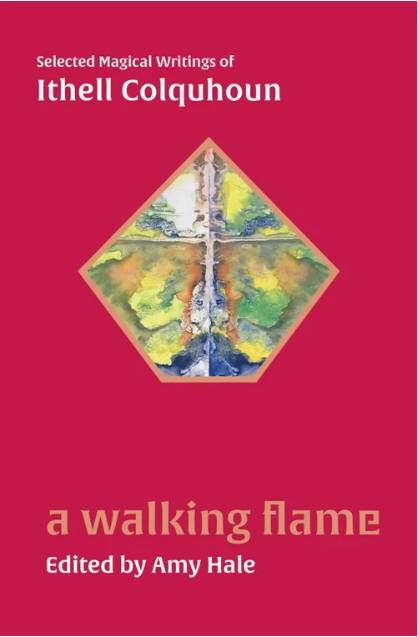
A Walking Flame: Selected Magical Writings of Ithell Colquhoun: Amy Hale (ed) Strange Attractor Press, London, 2026. 336pp & 16 pages of colour illustrations. Unlimited paperback & limited hardback edition of 300. https://www.strangeattractor.co.uk/publications/walking-flame
|
|
|

 One
of the most interesting pieces in the book is the previously unpublished
Lights in the Air (p.165), the title Colquhoun gave to her
collection of contemporaneous notes of her observations of unidentified
anomalous aerial phenomena. In it we clearly see her thought processes
in action. First she gathers her notes of her own sightings, then she
devises a system for their classification before going on to discuss
several possible explanations. Bar the experimental testing of her
hypotheses (which would present obvious practical difficulties), what is
this if not the method of science in action: data gathering, hypothesis
generation followed, where feasible, by practical testing? Yet
frequently in her writings Colquhoun prioritised sensation and intuition
over reason and is disparaging about what she termed ‘discursive
mentation’. It was a tension, a creative opposition, that generally
served her well but sometimes led her astray, such as her excursions
into Celtic pseudo-history, documented here by such pieces as the
two-part Wisdom Tradition of the Gael (p.189). Colquhoun’s
approach combined a serious intent and an intellectual independence with
a demand for precision and yet this was often accompanied by a naïve
credulity that sometime spilled into gullibility.
One
of the most interesting pieces in the book is the previously unpublished
Lights in the Air (p.165), the title Colquhoun gave to her
collection of contemporaneous notes of her observations of unidentified
anomalous aerial phenomena. In it we clearly see her thought processes
in action. First she gathers her notes of her own sightings, then she
devises a system for their classification before going on to discuss
several possible explanations. Bar the experimental testing of her
hypotheses (which would present obvious practical difficulties), what is
this if not the method of science in action: data gathering, hypothesis
generation followed, where feasible, by practical testing? Yet
frequently in her writings Colquhoun prioritised sensation and intuition
over reason and is disparaging about what she termed ‘discursive
mentation’. It was a tension, a creative opposition, that generally
served her well but sometimes led her astray, such as her excursions
into Celtic pseudo-history, documented here by such pieces as the
two-part Wisdom Tradition of the Gael (p.189). Colquhoun’s
approach combined a serious intent and an intellectual independence with
a demand for precision and yet this was often accompanied by a naïve
credulity that sometime spilled into gullibility.