|
|
| home | exhibitions | interviews | features | profiles | webprojects | archive |
|
A Book of Holes: Abigail Reynolds at The Exchange, Penzance Rupert White
For most of the 1800s the town of Redruth was the commercial centre of Cornwall's mining industry. Although it is now home to Kresen Kernow and the artists' studios at Krowji, the town's buildings are a constant reminder of its more illustrious past. Nearby are several wild, gorse-covered hills, and one of them, Carn Marth, has an abandoned quarry at its summit. Intriguingly, the quarry's roughly-weathered walls are peppered with an array of deep, enigmatic holes that early in the last century, were created by rock drills.
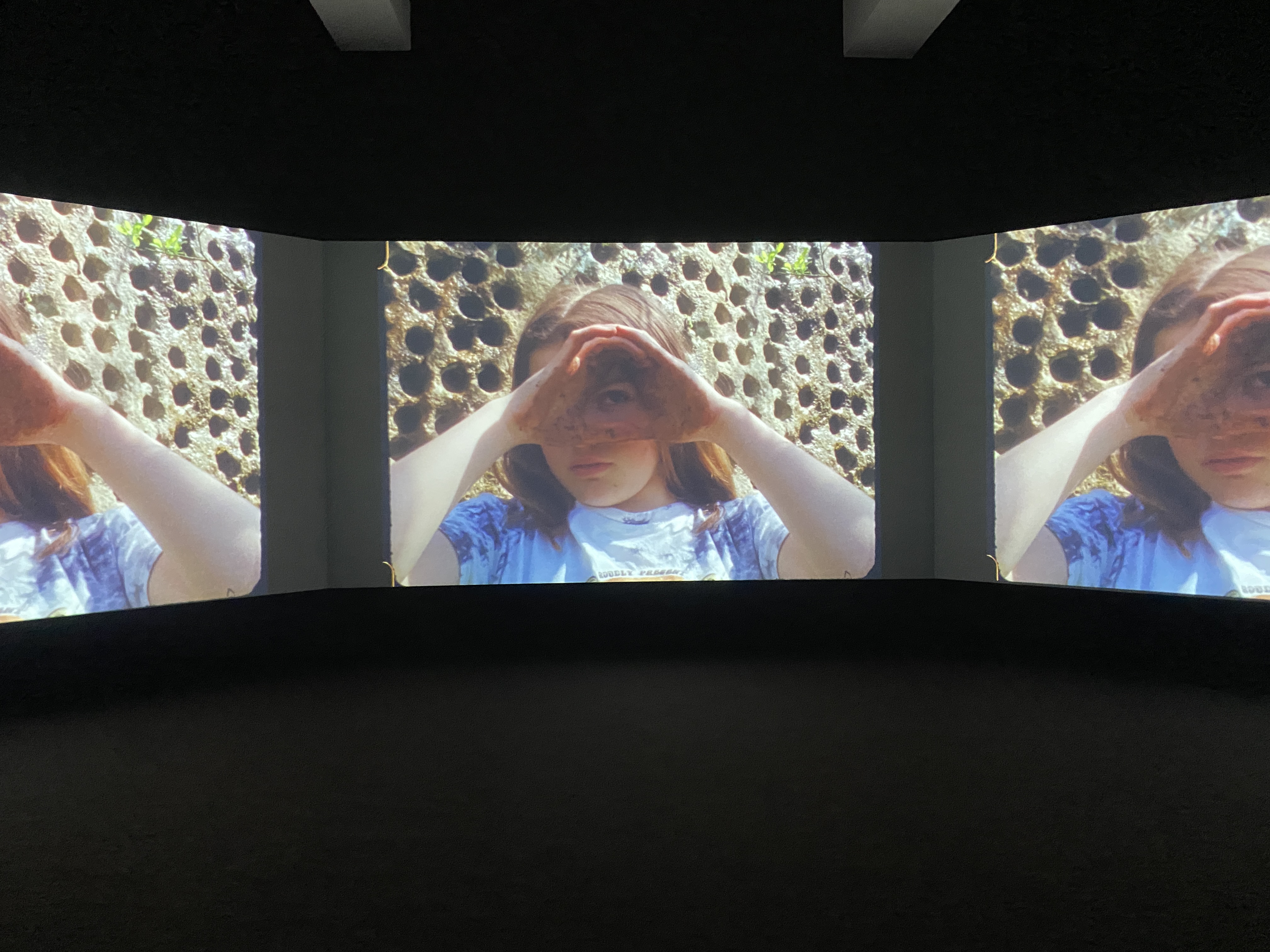
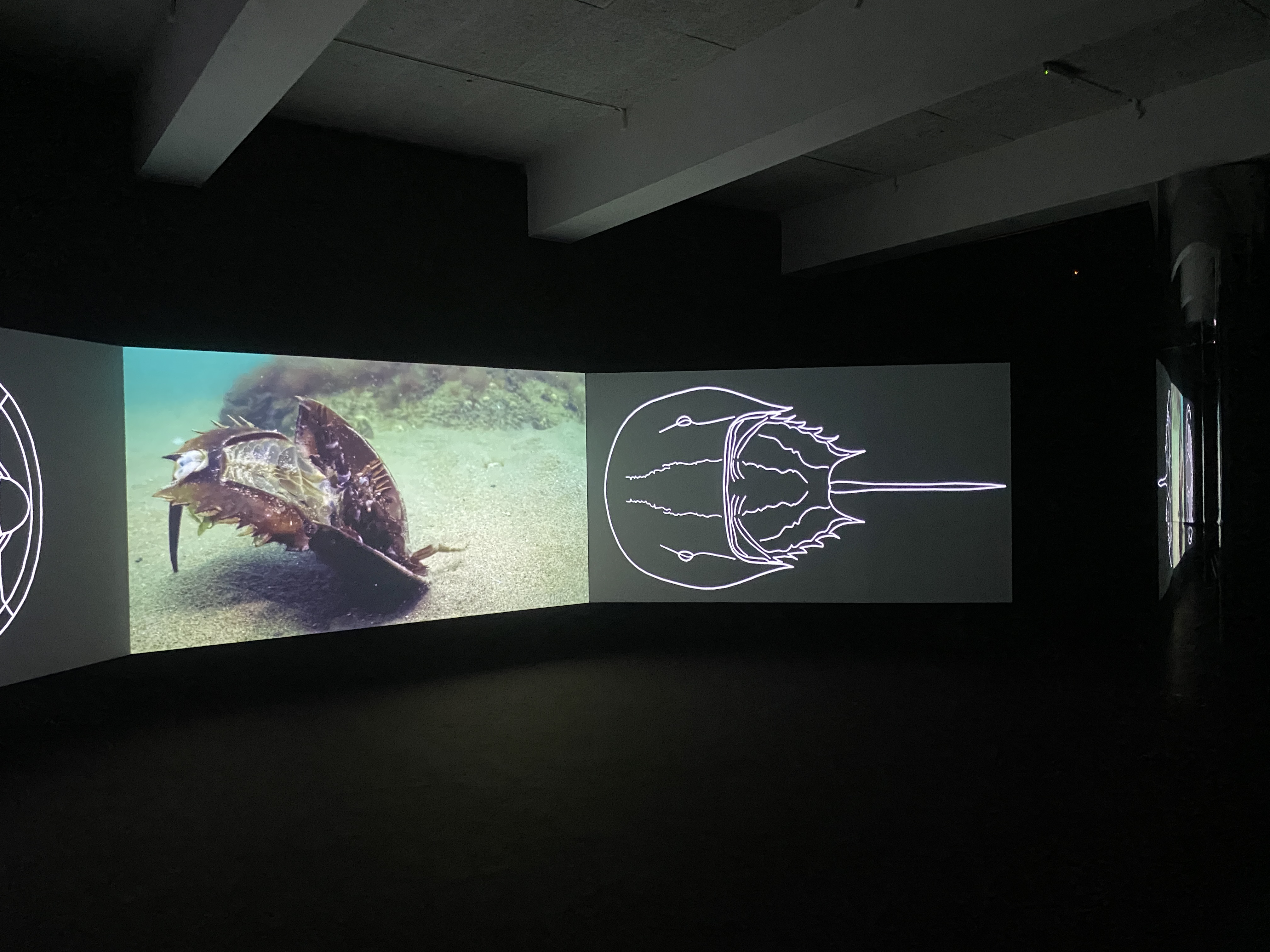
Abigail Reynold's 'A Book of Holes' is a 13 minute, three-screen video currently showing at The Exchange in Penzance as part of her survey show 'Walking A Cappella'. The quarry on Carn Marth provides the video with an anchor in the present, as early in the film we hear the drilled holes emitting a series of thumping and popping sounds as they are hit with sticks by Reynolds' family and friends. These sounds are subsequently transformed into a relentlessly pulsating EDM track, 90s ambient house style, that accompanies the video for its duration and, in Penzance, fills the gallery space with sound. It is increasingly accepted that some ancient stone monuments, including the blue stones of Stonehenge, served as lithophones, or musical instruments, but otherwise the connection between music, mining and the quarry may seem tenuous. However, just as post-industrial coal mining towns, like Sheffield, became centres of electronic music in the 1980s, in Cornwall too there was a rave scene out of which Warp records and artists like Aphex Twin and Wagon Christ emerged. Famously, in fact, John Peel's 'Sound of the Suburbs' features an interview with a very young Richard James and Luke Vibert in Gwennap Pit, a mere stone's throw from Carn Marth. This should not be a surprise because James, or Aphex Twin, grew up and made his first recordings in Lanner, the village on the outskirts of Redruth, at the foot of Carn Marth.
If the scenes at Carn Marth anchor Reynolds' video in the here and now, much of the rest of it speaks, hauntologically, of the past. There is colourful footage of Cornish miners, probably working in the 50s or 60s - when Holmans in Camborne was still making rock drills - and images of trilobite fossils, and horseshoe crabs, which evoke a much more ancient geological time. The miners and the crabs are linked by copper: bright blue copper oxides stain the walls of many Cornish mines, whilst copper in the form of haemocyanin, is also present in high quantities in the blue blood of the horseshoe crab. Some of these connections are explained in the voiceover to the film, as we see a succession of images flit between the three screens, but the overall effect of this loud, breathtaking collision of ideas, is one of poetry. Many of Reynolds sculptures - especially the more recent works in glass - reference Cornish modernism of Lanyon and Hepworth, but 'A Book of Holes' is more conceptual, reminiscent in some respects of Robert Smithson, the land artist. Certainly Reynolds works with the intellectual rigour of a conceptual artist, but this is always tempered by her inventiveness and sense of play, and by her awareness of the value of working collaboratively alongside others.
The Aphex Twin resource 'The Lanner Chronicle' is recommended https://lannerchronicle.wordpress.com/ See following interview for 80s music scene in Sheffield https://www.artcornwall.org/interviews/Adi_Newton_.htm Abigail Reynolds: Walking A Cappella 9 DEC 2025 – 2 MAY 2026. See 'Exhibitions' for installation shots at both Newlyn and The Exchange. |
|
|