|
|
| home | exhibitions | interviews | features | profiles | webprojects | archive |
|
Figgy Dowdy's Well Rupert White
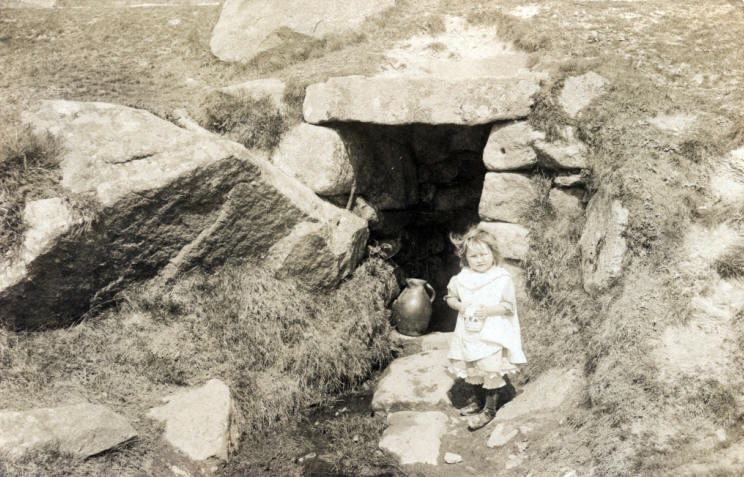
Situated near the top of the majestic hill of Carn Marth, as it towers over Lannernear Redruth, is an impressive and imposing well, its gloomy interior covered by an ominous looking heavy grille. It is less than a hundred yards from a quarry recently repurposed as an amphitheatre[1], and is surrounded by dense vegetation and a large grey willow tree. A delightful photograph from c1900 indicates that its heavy stonework - with two drilled holes for a door - is unchanged but it was, then, a much more open site. It was also, evidently, a valued water source for people living in Lannerand the surrounding area. The OS maps from 1878, where it is marked by a ‘W’, indicate that, unlike now when access is via granite steps from a road above it, it was approached by a path from below.
Figgy Dowdy well c1910, Carn Marth Paddy Bradley cornishmemory.com
Figgy Dowdy’s well was not recognised by the Quiller-Couchs, but it has garnered more interest since the 1980s when it was included in Meyrick’s survey (1982). This is largely because the folklore that attaches to it has only come to light in more recent times. Its name is not apparent on old maps or in early newspaper reports, though an article from 1896 (Cornubian Times, 21st February) refers to a ‘Piggy’s well’ on Carnmarth. The name, however, was recorded by James (1949)[2], who also included a photograph and a short rhyme. Figgy Dowdywas a person, it seems: "Figgy Dowdy had a well On top of Carn Marthhill She locked it up night and day Lest people carry the water away!" An intriguing argument has been made for Figgy Dowdy being the Cornish name of an ancient harvest goddess (Norfolk, 1995)[3]. However in 1993 (13th May) a Bissoe resident wrote to the West Briton, offering a version of the rhyme he knew as a child. It suggests Figgy was, in fact, a man: "Figgy Dowdy had a well On top of Carn Marthhill Locked un’ up night and day Lest people carry his water away!" In response to the letter Michael Tangye of RedruthOCSseemed to confirm this (West Briton 20th May 1993): Figgy Dowdywas probably Philip Manuel, a mentally ill and controversial character who lived at Carnmarthin 1836 and who was treated as an idiot by his neighbours. He was nicknamed ‘Maze Figge’ (Mad Figgy) and one day shot and killed one of his daughters when she came to visit him. Because of his mental state he was acquitted of murder and detained in custody (RCG 1836). Multiple newspaper reports from spring 1836 confirm Manuel’s nickname as ‘Mazed Figgy’[4] and, also, that he was often taunted by local youths. Witnesses at the assizes said Philip Manuel’s mother and father had both been mad, his mother confined for many years and, as reflected in the rhyme, that Philip himself had, for a long time, believed that people were out to rob him. Consequently he kept a number of lethal weapons with which to protect himself (RCG April 8th 1836). The daughter that he shot, Caroline, was a teenager who lived with her mother at a different address. Five foot nine and a miner by trade, Manuel was 61 when the act was committed, and he was acquitted on the grounds of being insane. He was sent to the asylum in Bodmin, where he died less than four years later, in December 1839. James (1949) provides another possible name: ‘Margery Daw’s Well’[5]. Though there is no corroborative evidence for this (i.e. the name doesn’t appear in any other historical sources), it is interesting because a Cornish Margery Daw appears in in Hunt’s collection of Romances (1865). It is possible though that Margery Daw was simply another derogatory nickname for Philip Manuel: ‘Mazejerry’ is noted in a number of dictionaries (eg Jago 1882) as a dialect word for a mad or crazy person, and it is easy imagining this mutating to ‘Margery’[6]. Recently, with the revival of dolly dunking at Fenton Bebibell (see later entry), there has been much interest in another previously overlooked anecdote. Cornish historian A K Hamilton Jenkin (1934)[7] tells us: “To a spring, known as ‘Figgy Dowdy’s’ Well on Carn MarthHill, near Redruth, it was customary within comparatively recent years for children to take their dolls on Good Friday, in order to have them ‘baptised’. An old resident in the neighbourhood used regularly to attend to perform the ceremony. This curious custom was at one time not confined to the Redruth district, as a lady now residing in Hayleinforms the writer that when a girl she remembers taking her dolls to a well on Carn Galva, in Morvah, for a similar purpose.” The Carn Marthreference relates closely to an anecdote in Courtney (1890)[8] that was subsequently repeated elsewhere (eg RJIC vol.13) "On the afternoons of Good Friday, little girls of Carharrack, in the parish of Gwennap (West Cornwall), take their dolls to a stream at the foot of Carnmarth, and there christen them. Occasionally a young man will take upon himself the office of minister, and will sprinkle and name the dolls." - Charles James, Gwennap[9]." Whilst properties in the upper part of Lannerused Figgy Dowdy’s well, the rest of the village was relatively well served by water, and in fact, in 1900, had a drinking fountain installed, paid for by a local woman called Maude Pascoe. However Carn Marthcontinued, for many years, to provide the water for Carharrack, which was sent to a shute on the eponymous Shute Hill. Many in Carharrack went to the shute themselves or relied on door-to-door deliveries of water from a man with a horse and cart. In St Daythis man was James Williams who would have collected water from Vogue Shute, to distribute it locally. [1] Managed by the Carn Marth Trust [2] James, C.C. (1949) History of the Parish of Gwennap. [3] Norfolk’s argument is complex but persuasive, and links ‘dolly dunking’ to the Margery Daw rhyme found in Hunt (1865). [4] The second name ‘Dowdy’ would have been appended to the first, as it was a well-known pudding, traditionally eaten by sailors at sea. [5] Henderson (1956) gives a version of the rhyme that begins: ‘St Margery Daw had a well’. [6] Thanks to Andy Norfolk for spotting this. [7] A K Hamilton Jenkin (1934) Cornish Homes and Customs [8] Margaret Courtney , Cornish Feasts and Follklore, 1890, p159 [9] West Briton (26th August, 1915): Charles James (1858-1915) of Comford, Gwennap was 67 when he died suddenly. He was the parish clerk, and active as a lecturer, particularly on folkore. He was the father of C C James, who was a geologist and the author of ‘History of the Parish of Gwennap’. Adapted from 'The Holy Wells of Cornwall: revisited' Antenna Publications 2024 |
|
|