|
|
| home | exhibitions | interviews | features | profiles | webprojects | archive |
|
Fishy fairy-tale: Rose of Nevada Rupert White
Mike (played by Ed
Rowe), an aging local business man, decides to put it back out to sea,
so recruits a chain-smoking old sea-dog
known as Mergy (Francis Magee) and two much
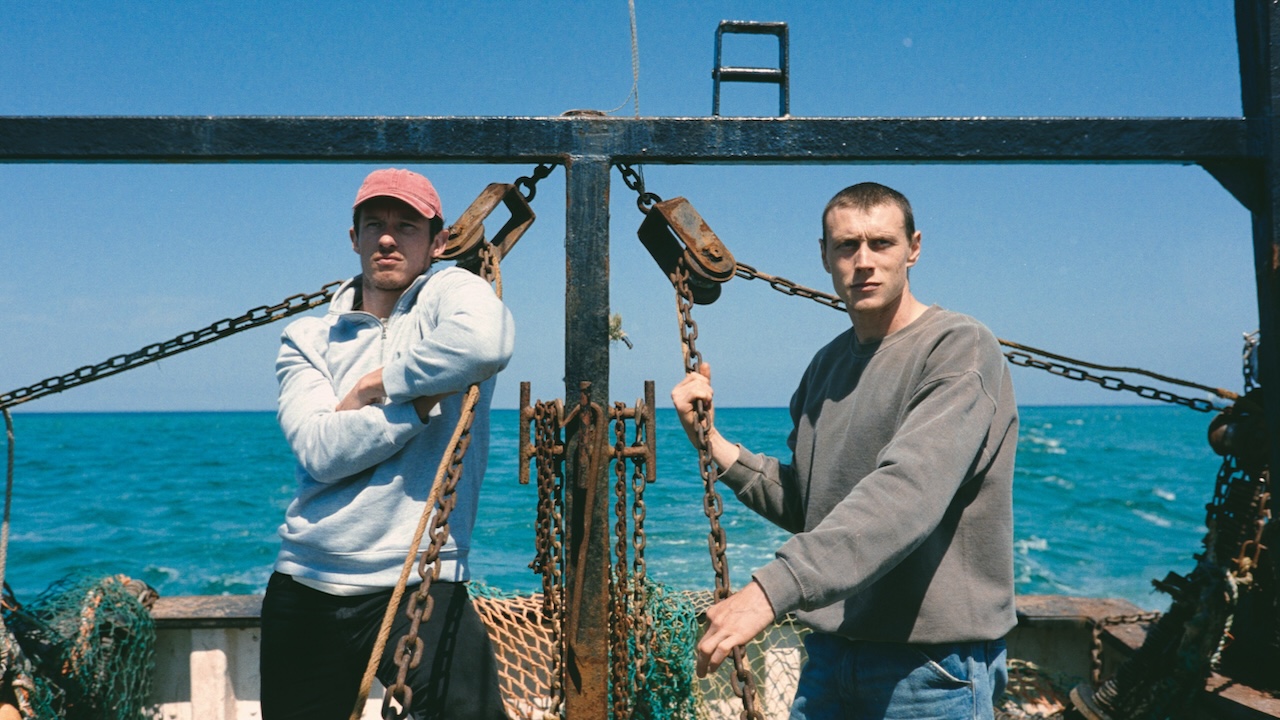
younger deck hands: Nick (George Mackay) and Liam (Callum
Turner - both pictured above). We're not
told too much about Mergy or Liam,
but Nick who lives next to a grieving
elderly couple called the Richards, is struggling
with a young family, and a flat roof that leaks when it rains. When they come back from this, the first of several fishing trips, Liam and Nick discover that the clocks have turned back 30 years. The quay is busier, the pub is busier, the food bank has returned to being the village post office, and villagers like Mike look younger. Not only that but, more profoundly, all the locals seem to accept Liam and Nick as the original crew members of the boat, Alan and Luke, who we only otherwise see in flashbacks and photographs. (Luke, incidentally, is portrayed by Sam Bassett, the St Ives painter - see artcornwall.org interviews). So accepted are they that Liam is able to hook up with Alan's old wife, Tina (Rosalind Eleazar), and Nick is adopted as their son by the Richards. This, the spine-tingling central premise of the film, is fascinating but really hard to comprehend. How is it possible? Why are the villagers so accepting? Is it - à la The Wicker Man - a creepy conspiracy in which they are all complicit? If so, is it a one off, or are we in fact witnessing a weird ever-repeating time loop? Like other Jenkin films, the dialogue is sparse, and any additional clues cryptic and fleeting. Perhaps, though, 'Rose of Nevada' should be thought of as a fairy-tale, in which logic is placed aside, and such questions are never fully answered. I say this, mindful that time-travel (or time-warping), is a feature of many Celtic folk-tales, not least Bottrell's 'Dwelling on Selena Moor'; a story set on a patch of land between St Buryan and Penberth (now spelt Silena Moor) not far from Penzance and Newlyn.
Mark Jenkin (who as well as being the director is also, of course, the camera man, sound man and editor) deserves much credit. The film 'Rose of Nevada' was made with the same wind up 16mm Bolex camera, and many of the same actors, as its two predecessors. All three titles have a beautifully personal hand-crafted quality, and though 'Rose of Nevada' attracted quite significant funding, in making it Jenkins kept to his formula, and his loyalty to Cornwall both as a subject and setting. Despite 'Bait' being a film about the fishing industry, fishing at sea was almost entirely absent from it. 'Rose of Nevada' more than makes up for this, with several scenes being filmed off shore. Apparently, though, the night-time storm scenes were created in the harbour in Hayle, using jet-skis to throw water across the deck. Scenes inside the cabin of the boat, meanwhile, were shot in an improvised studio in an industrial estate, also in Hayle. Other locations included Gwinear Churchtown (used for the village street) and Mullion (for the quay). That
a film like this could be made in rural Cornwall, under such
circumstances, is both remarkable and
encouraging, at a time when cultural capital
in the entertainment industry
seems to be increasingly concentrated in the hands of
a few super rich
corporations. https://www.artcornwall.org/features_/Rupert_White/Bait_Mark_Jenkin.htm https://www.artcornwall.org/features/Rupert_White/Enys_Men.htm 30.4.26 |
|
|