|
On the Numinous
Qualities of Scilly’s Labyrinths
Teän Roberts
On the tiny island of St Agnes - the most rugged and remote of the Isles
of Scilly and the most southwesterly inhabited land in Britain - there
exists, against all probability, a small pebble labyrinth, which has
endured on this spot for at least three centuries. Troy Town Maze (all
Scilly’s labyrinths are known locally as “mazes”) faces West, looking
out towards the Western Rocks - the most treacherous of Scilly’s
notorious waterways - and then onwards out over the sea. This site marks
the last point of safe land before the perilous yet enthralling wilds of
open ocean.
Troy Town Maze is Scilly’s oldest labyrinth, and it is unique in that it
is the only pre-20th century pebble maze in the UK. But since its
construction, many more labyrinths have appeared across the islands.
These mazes - sprouting, fading, reemerging, sometimes vanishing, like
fairy ring mushrooms constellated around this mysterious original - make
the Isles of Scilly home to the largest collection of stone labyrinths
in Britain. The purposes of these labyrinths are unclear, but it seems
evident that there is something dwelling in the landscape of this
mysterious and numinous archipelago, which compels folk to create and
recreate these poignant magical symbols time and again.
The labyrinth symbol has countless supernatural meanings and uses across
cultures, many of which would be applicable to Scilly. Similar pebbles
mazes in Scandinavia were known sites of magical rites to aid fishing,
where piskie-like “little-people” - known as the smågubbar - would be
lured into the labyrinth’s coils to prevent them from causing bad luck
on the boats. Labyrinths were used by seafarers in weather magic to
raise favourable winds and to improve mental health. They were also
thought to assist in pilotage and nautical navigation, particularly
during the Medieval period.
Closer by in Cornwall, images of labyrinths
also proliferate, though these are small labyrinths carved into stone,
rather than the walkable pebble mazes of Scilly and Scandinavia. Two of
these labyrinths, carved into a rock face at Rocky Valley near Boscastle,
are rumoured to be relics of a 17th century witch-cult and share
similarities with the carved Troy Stones (one of which resides in the
Museum of Witchcraft and Magic) which are used by Cornish witches to
access trance states and to “enter and return from the world of spirit.”
When writing about Troy Stones, Cecil Williamson (founder of MWM)
described the proximity to Rocky Valley’s carved Labyrinths as a reason
for locating his Museum in this area, claiming that here “one is
standing on the edge of the beyond.” This is the same feeling
experienced when standing at Troy Town Maze. Situated at the edge of the
vast ocean, skirting the cusp of the known, the maze seems to offer an
extension into the unseen, a reaching forward - through the labyrinth’s
coils - towards something else glimpsed over the land’s edge or through
the unearthly veil.
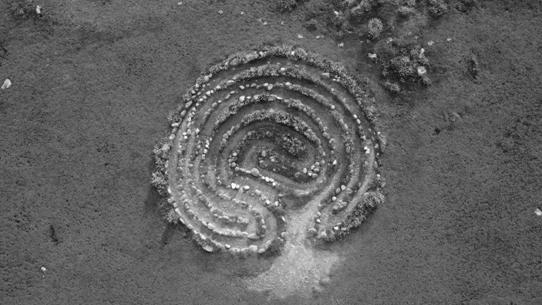
Troy Town Maze, St Agnes 2025. Photo Teän Roberts
2025.
The accepted origin story of Troy Town Maze seems at first glance to be
far more terrestrial and mundane than Viking sailors working
weather-spells or witches creating magical portals. It was reportedly
built by the son of the St Agnes lighthouse keeper named Amor Clarke in
1729. Nothing more is known of Amor Clarke (most of the Trinity House
archive was destroyed by bombing during WWII and St Agnes parish records
of the time were lost in a fire) and we are left wondering why the son
of a lighthouse keeper on St Agnes would have made such a thing? But
Scilly is an extraordinary place, and attracts a curious breed of
people, so I resist the temptation to categorise: “lighthouse keeper’s
son on remote, rural, 18th Century island” equals “unimaginative,
parochial and incapable of working magic, be that intentionally or
intuitively.” The truth is we know nothing at all about Amor Clarke, and
as such the maze’s origin is ripe for projection from all sides.
One thing we do know for
certain is that there are no smooth, round sea pebbles like those used
in the maze’s construction adjacent to its location, and so Clarke must
have carried these across the headland from nearby White Par. From our
own experience restoring another of Scilly’s mazes this summer, we can
speak with assuredness that moving these pebbles around is heavy,
arduous work, and they are not something you would want to transport
further than necessary without a very good reason. There are perfectly
good, flat stretches of land adjacent to White Par where Clarke might
have made his maze, but chose not to, so we know that the maze’s
placement, facing West towards the most hazardous rocks and reefs in
Scilly, must have been of some importance.
Perhaps Clarke was rebuilding an older maze
on the site, left by medieval explorers or marooned Viking raiders?
Perhaps he was a sailor himself who had travelled to distant
Scandinavia, seen the labyrinths and their uses there, and brought this
custom back home? Perhaps he was an initiate into the same 17th Century
witch cult responsible for the Rocky Valley labyrinths - as we know that
“the inhabitants of the Scilly Isles came over in crowds for the purpose
of consulting the white witches of Cornwall, and that they might obtain
their protection charms, spells and counter-spells”? Perhaps he was also
gripped by the archetype in the land that expresses itself through these
eternally surfacing labyrinths? For me, it is this last idea of
archetypal possession that I am proposing to project onto our unknowable
lighthouse keeper’s son:
“Archetypes were, and still are, living
psychic forces that demand to be taken seriously, and they have a
strange way of making sure of their effect. Always they were the
bringers of protection and salvation.” - Carl Jung
This idea - that the universal labyrinthine
archetype, with all its associated magical implications, is bubbling up
on the islands - felt increasingly likely after the discovery of this
alchemical image of a pilgrim walking a labyrinth beside a lighthouse,
while ships scud across a windy sea behind (see picture). This prophetic
image is utterly uncanny in its resemblance to the real site of Troy
Town Maze and St Agnes Lighthouse, as it dates from 1622, predating the
construction of the lighthouse by 58 years and the maze by 107. Jung
argued that alchemical images were manifestations of the collective
unconscious with an archetypal root, and this seems to be the case for
this picture representing the same archetypal emanation as is evident on
St Agnes, from 600 miles and 107 years distant.
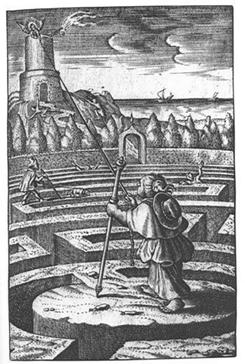
A Labyrinth near a lighthouse by Hermann Huge (1622)
I have felt a similar archetypal unconscious force at work on me in
connection to a different labyrinth on nearby St Mary’s. This turf and
stone labyrinth named Giant’s Castle Maze sits beside the eponymous Iron
Age Cliff Castle on St Mary’s and was a predominant part of the
imaginative landscape of my childhood growing up nearby, as my family
told me it was made by the fairies. It had become near-terminally
overgrown by the time I moved back to Scilly in 2024, so my partner
Layan and I conceived a community engaged public art project (funded by
the Arts Council with the support of the Isles of Scilly Museum) to
restore this ruined maze to a usable labyrinth again.
Little was known about its origin, but
during our research we discovered that it was constructed by two
children - aged 11 and 13 - in the summer of 1952 when they were living
nearby. Whether they were fairy-led or possessed by the archetype of the
labyrinth we do not know. Nevertheless, we invented a new mythic ritual
to celebrate the ceremonial re-opening of this maze post restoration for
although it is a relatively recent site, we wanted to reimagine some of
Scilly’s lost mazey folklore and reenchant this nearly-lost piece of
folk art at the same time.
Compared to nearby Cornwall, Scilly has
very little surviving folklore, due to the loss of the oral history
tradition which accompanied the huge depopulation of the islands when
Augustus Smith became “Lord Proprietor of the Isles” in the early 19th
Century. Before this loss, we presume that this island landscape, so
rich with ancient monuments and curiosities like the mazes, must have
had accompanying folk stories. So we looked at labyrinth myths from
elsewhere - predominantly the most famous labyrinth myth of Theseus and
the Minotaur from Crete - and considered how this might have applied to
Scilly.
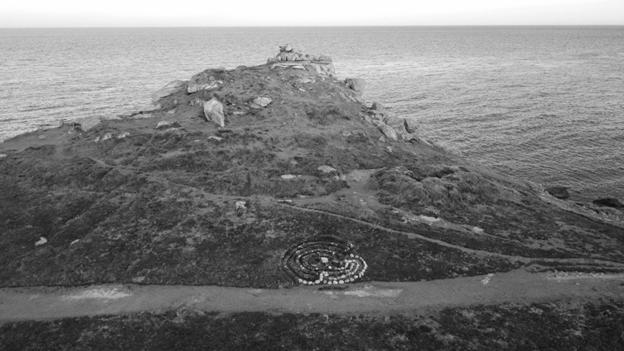
Giant’s Castle Maze (post restoration) 2025. Photo
Teän Roberts.
The location of Giant’s Castle Maze, in the shadow of a defensive Iron
Age Cliff Castle, and our choice to hold our mazey celebration at
Lammastide (when historically the islands would be most vulnerable to
pirates and raiders, due to favourable seafaring weather) highlighted
the need for the magical protection of a localised Wild Man myth: a
Minotaur for the islands. In this way we would invite in the dangerous
unknown, making it solid and knowable, in order to defeat or transmute
its power. But instead of a beast half-man-half-bull we decided to make
the Scillonian Minotaur a snail, as the Cornish word for “snail” is
“bullhorn” and snails’ spiral shells are often associated with
labyrinths, not least via the Cornish “Snail Creep” dance, which we also
danced at our maze reopening celebration.
We knew we did not want to slay our Minotaur, but for it to be soothed
and tamed by mischief and tenderness. So instead of the warrior Theseus,
our counterpoint to the Bullhorn is a jester character called the Biggal
Fool (“biggal” is a Cornish term meaning “shepherd” or “keeper”) as
jesters and clowns are often considered creatures of the liminal in
folklore. In our mummers play the Biggal Fool approaches the fierce
Bullhorn, prances around it until it is tamed and then leads it out of
the maze via a red thread (a homage to the Cretan Ariadne). It then
bestows blessings on the audience members, because we knew that snails
are considered good luck in Cornwall.
When designing this pageant of new myth, we believed that it was our
conscious imaginative choices alone that were determining the practices
we devised. But since recently being introduced to the work of
traditional Cornish witchcraft expert Gemma Gary, and coming face to
face - in the pages of her books - with so many of the practices we
believed we had made up, I am now sure that it was the magic present in
the island - latent under the land and beneath the labyrinth lore - that
was influencing our work and guiding our hands unseen.
Firstly, the similarity between the Bullhorn and the Biggal Fool with
the Obby Oss and their “Teazer” - a mischievous prancing figure that
accompanies the Oss as it stalks the streets at the major Cornish
Festivals, now revived in nearby Penzance. Secondly, the snail’s
“ability to bestow blessings upon places and people,” mirroring our
Bullhorn blessing the audience. Thirdly, the snail’s association with
“power - sexual force, fertility, fecundity and creation” in Cornish
folklore - all potent attributes also applicable to bulls in ancient
Crete, where the Minotaur myth originates. And fourthly, the existence
of a “Lammas feast tradition” that is celebrated “with maze walking and
feasting in the moors and fields near Morvah, showing that mazes have
been involved in existing Lammas festivals as nearby as West Penwith.
All these elements, previously unknown to us, were so synchronous with
our invented maze celebration, that we were reminded - yet again - that
magic is well and truly real.
It seems that the labyrinthine energies that exist on the islands were
enthusiastically exerting their influence; dredging up forgotten local
folk customs via their otherworldly portal-paths and syphoning them into
our creative outputs. And the results were surprisingly meaningful and
moving - with audience members brought to tears and full of praise and
gratitude for this opportunity to reconnect to the storied landscape.
But to what purpose? If - as Jung says - archetypes are the bringers of
protection and salvation - what is Scilly’s labyrinthine archetype
trying to instill in us, for our own growth and evolution?
Through this work it has been made evident to us that people are hungry
for folklore and a lived relationship with myth. Our human world has
been separate from the magic in the land for too long, and we need to
take a turn towards that which is unseen yet rooted again. Rising as a
counterpoint to this, the energies within the earth want to be
remembered and worked with and they are keenly making their presence
felt.
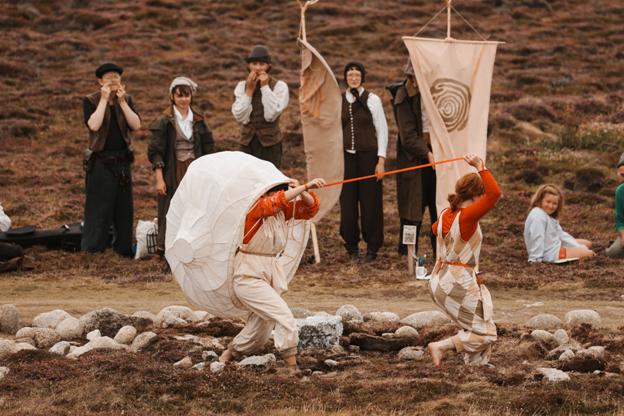
The Biggal Fool leads the Bullhorn 2025. Photo Inga
Drazniece.
The entrance into other
worlds, including the land of the mythic, is never straightforward and
labyrinths (as well as other symbols) can act as an entryway into this
mystery. Travelling these paths this year - this brush with the numinous
and the archetypal - has been a convoluted route deeper into mystery,
and is something we want to bring with us as we turn and make our way
out of our Scilly labyrinth project and head into future things. We
haven’t travelled far, but through this work with this symbol on these
islands, we are ever changed.
If you would like to learn more about the Scilly
Labyrinths Project please take a look at our website:
www.scillylabyrinths.com
or follow us on Instagram: @teanroberts and @aeonlung
|
