|
Alastair and Fleur Mackie on London, Cornwall, materials and process
e-interview
Rupert White
I understand you're
based in the Delabole area of North Cornwall
now. What's your background and how did you
both find yourselves here?
Yes - home is a small cottage near Delabole, not far from Tregardock
beach.
We were both born in the same year but had very different upbringings.
Ally grew up in a farming community in the south of Cornwall, while
Fleur’s childhood was split between Cameroon, France and the UK - she
was born in a small village in the rainforest, so quite a different
starting point, although in both cases there was a close relationship to
the land.
We met in London in the late 90s at art school - Ally studying
sculpture, Fleur illustration - and ended up living there for about
fifteen years. That was really where everything began for us in terms of
working together. It wasn’t immediate or very structured - we were both
doing different jobs to get by and making things where we could.
Gradually that turned into something more consistent, and Ally took on a
studio space off Hackney Road.
We left London in 2011. We were ready for a change and wanted start a
family, and both of us felt a strong pull back to Cornwall.
We were lucky to find an ex–farm labourer’s cottage on the coast between
Port Isaac and Port Quin. It came with a barn which we used as a studio,
at an affordable rent, on the condition that we moved out when the Doc
Martin film crew returned to shoot a series - for five months every
eighteen months. We’d pack up and travelled while they were there, and
that arrangement lasted ten years. It was a happy time for us.
At the end of 2021 we moved to a smaller cottage at the other end of
Port Isaac Bay, and into a larger, newly built studio nearby in St
Minver, which has changed how we’re able to work quite a bit.
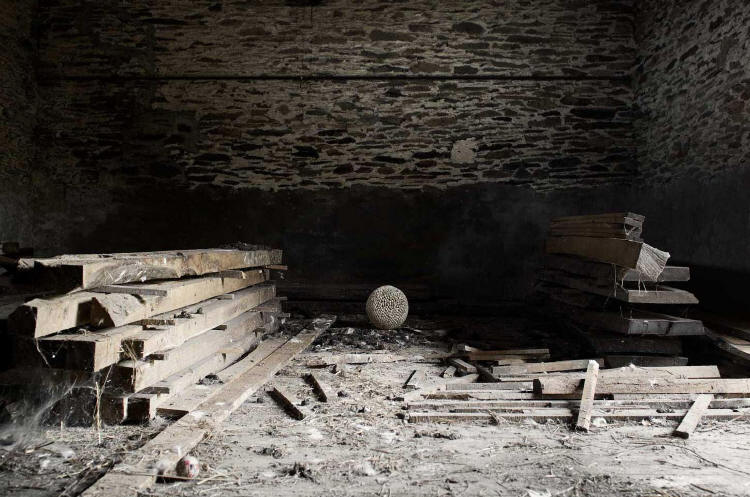
Untitled (Lansallos) 2010
Can you say more about the move from
London? In particular, how did it affect your
practice?
The move itself was a big shift, but the most important change was in
the pace of things. Everything slowed down - not just practically, but
also in how we approached our work. London has a very particular energy,
and we were making work within that system. It was a good time for us,
but we were young, and caught up in that pace.
In reality, we work very slowly.
Being in Cornwall allowed that to come into focus. We had more time,
more space, and fewer distractions, which meant we could follow things
through more carefully and let decisions emerge rather than pushing
them. The work became quieter, more deliberate, and more attentive to
what was already there.
It also shifted where the work begins. Instead of starting with an idea
and finding materials to fit into it, the process became more about
responding to what we encountered around us. That change still underpins
how we work now. More generally, it allowed
the work to become less driven by outcome and more by process. It takes
longer to arrive at things, but it feels closer to how we want to work.
West Cornwall has a lot of galleries and studios, and most of the
artists down there know each other. What is it like at the other end of
Cornwall? Do you feel cut off? Is that a problem?
Yes, we do feel quite isolated - we’re in the sticks!
Culturally, it can feel a bit removed, and we miss the ease of
engagement we had in London - being able to see things, and feel part of
a wider conversation. West Cornwall offers more of that, and we visit
fairly often. There’s a strong concentration of artists there, and a
shared way of thinking that we recognise and feel connected to. It’s
something that stays with us when we leave.
But over time, that isolation has built something too. Our relationship
with the immediate surroundings has become more personal - quiet, and
very direct. We’re on a ridge of high ground between the Atlantic and
Bodmin Moor, so we’re aware of those two very different conditions
either side. It’s exposed - open ground, very close to the underlying
material of the land - and that feels important to us, feeding directly
into the work.
At the same time, our way of working isn’t about this place as subject
in itself. It’s more about working closely with the specific
circumstances we find at hand - a way of paying attention that would
apply wherever we were.
So whether it’s a problem - yes and no. It can feel limiting at times,
but it’s also shaped the work in ways that feel important.
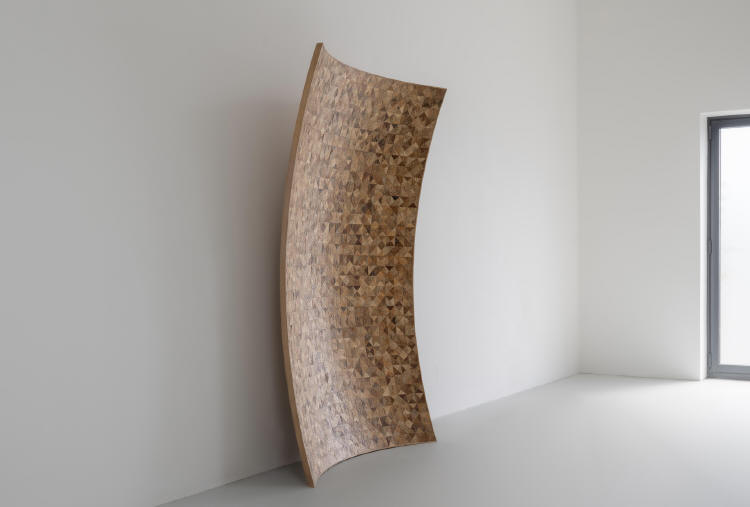
Canopy (2014-2025)
Can you describe one or two of your earliest 'Cornwall-made' works?
A lot of the work we were making in London was already rooted in
Cornwall.
Ally started working with found materials during his BA, including early
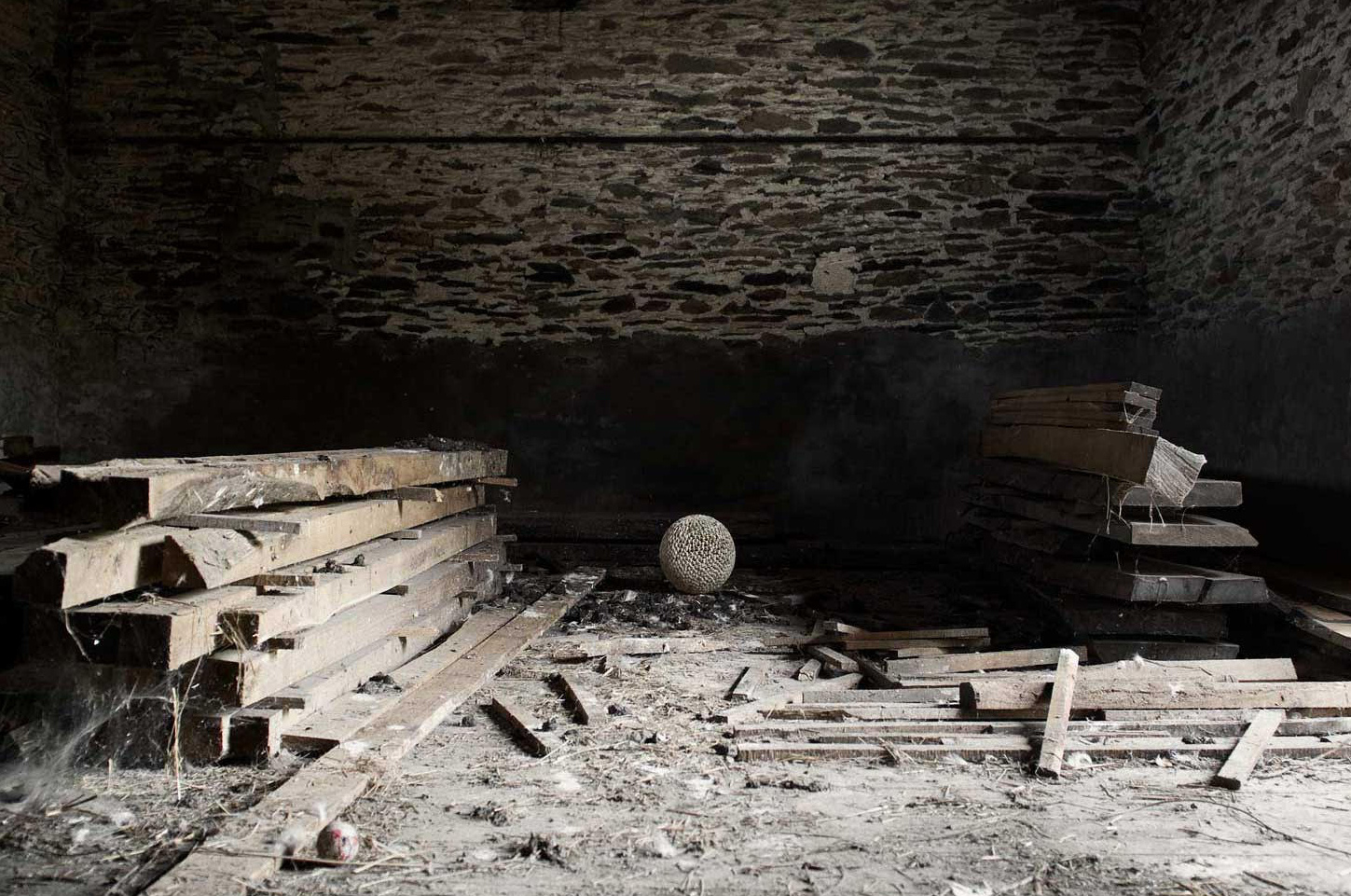
works using barn owl pellets (photo above (top)). We’d regularly travel back down to his
parents’ farm near Lerryn and spend weekends crawling around derelict
farm buildings. Those materials would then come back with us to London
and find their way into the work. In some cases, once the pieces were
made, they were taken back and documented where they were found, so
there was already a kind of back-and-forth between studio and site.
Even then, the work was grounded in the conditions in which the
materials were found, just at a slight remove.
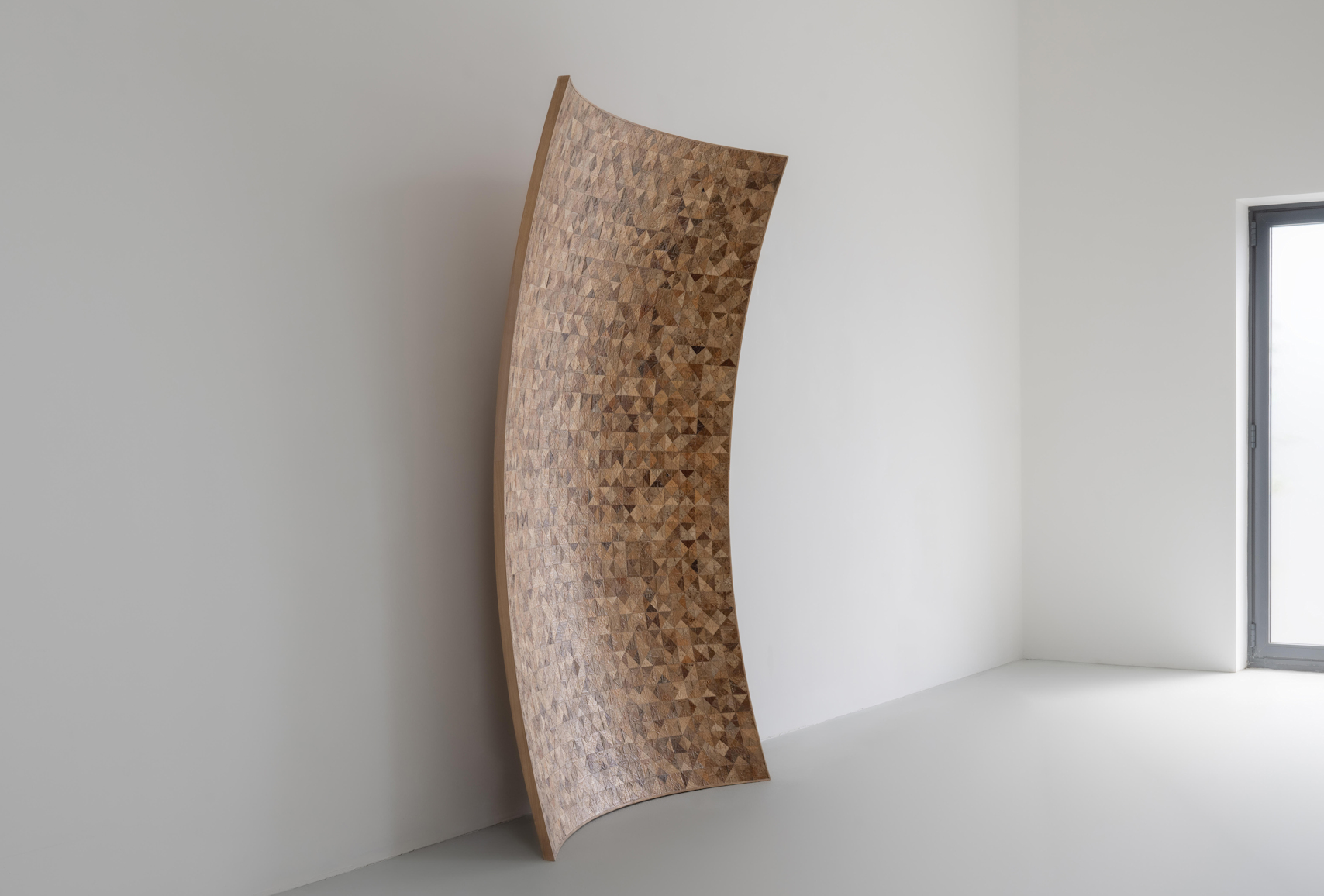
A piece where that relationship felt more direct was
'Canopy', which Ally made in 2014
(photo above).
It began as a walk - from our home at the time to the house where he
grew up - about twenty miles across mid-Cornwall
from one coast to the other. Along the way, he picked one leaf from
every tree he passed beneath. In total, 3,456 leaves were collected,
then pressed and dried. Each leaf was processed into a component and
used to form the surface of a faceted, geodesic structure.
The work was commissioned for an exhibition on the theme of home, and
that idea runs through it quite directly. It connects two specific
places through a simple, physical action, but also builds something new
from that journey - a structure made from what was encountered along the
way.
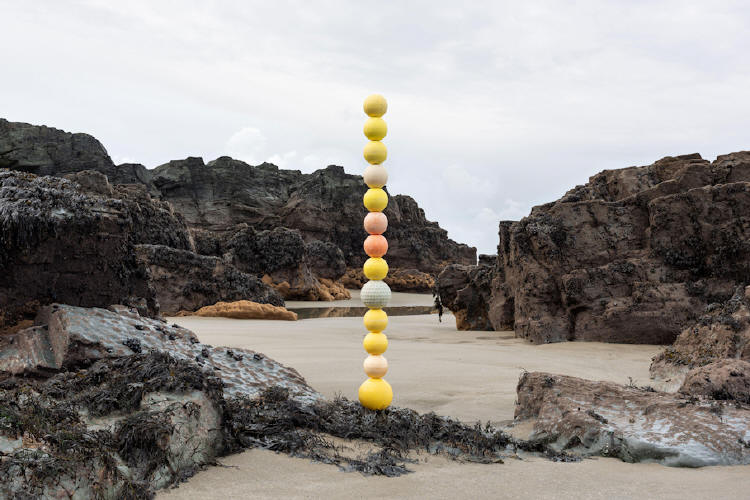
Stack 6 (2026)
Most of your recent work is a
response to the landscape in some way. Can you describe how you made eg
'Stacks'
(above) and
'One Mile Line' (below)?
Which beaches did you access in particular?
Most of this work begins with time spent in a relatively small area near
where we live.
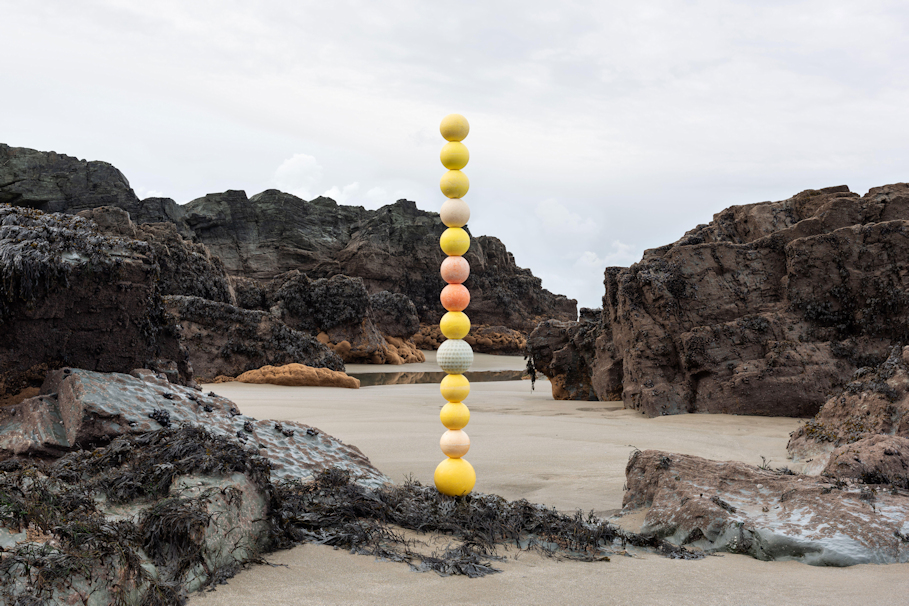
The Stacks developed from coming across large trawl floats lodged in
rock crevices along the shore at the north end of Port Isaac Bay.
They’re part of a vast industrial system - used to keep large fishing
nets open at sea - but here they arrive as isolated objects, carried in
by currents and storms.
We set ourselves a simple framework - a two-mile stretch of coastline
within walking distance of our home - and began recovering all the
floats we encountered along it. At that point we didn’t have a fixed
idea of what the work would become; we let it develop from there.
The structures came quite directly from the material. The floats already
contain fixing points from their original use, so we began using those
to hold the stacks together, allowing their prior function to determine
how they could be reassembled. The stacks were made on site where they
were found, subject to tide and weather, documented photographically,
then dismantled.
One stack led to another, and as more appeared, it developed into an
ongoing series.
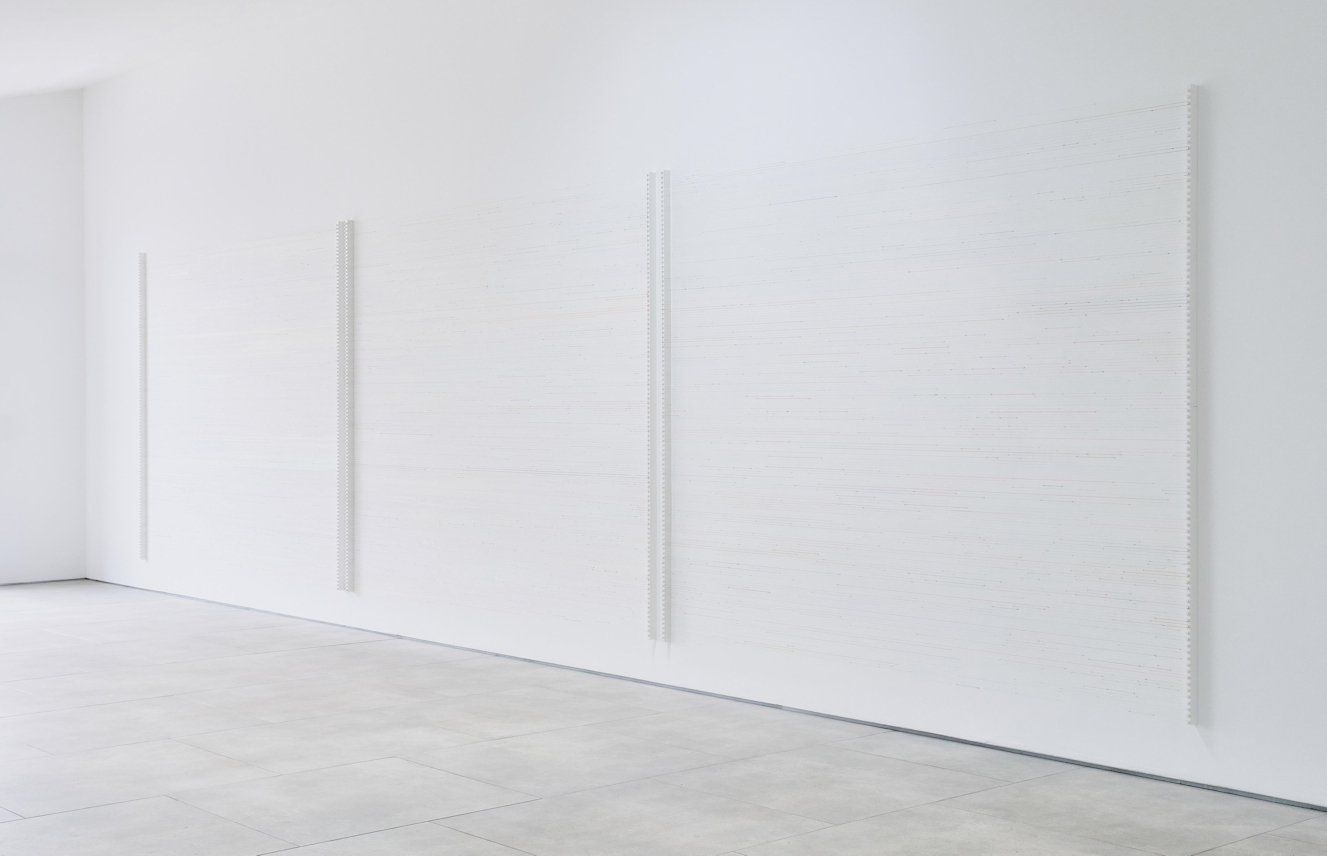
'One Mile Line' came
from a similar process of accumulation, but over a longer period and
from the other end of the bay, where this material is deposited. We
collected brightly coloured lengths of monofilament fishing line -
densely knotted and tangled - then unknotted, straightened, and rejoined
them into a single continuous line measuring one mile. Like the
stacks, it’s a work that emerges from
repetition and collection rather than a fixed plan at the outset.
In both cases, the starting point is paying attention to what’s there,
and allowing what we find to form the work.
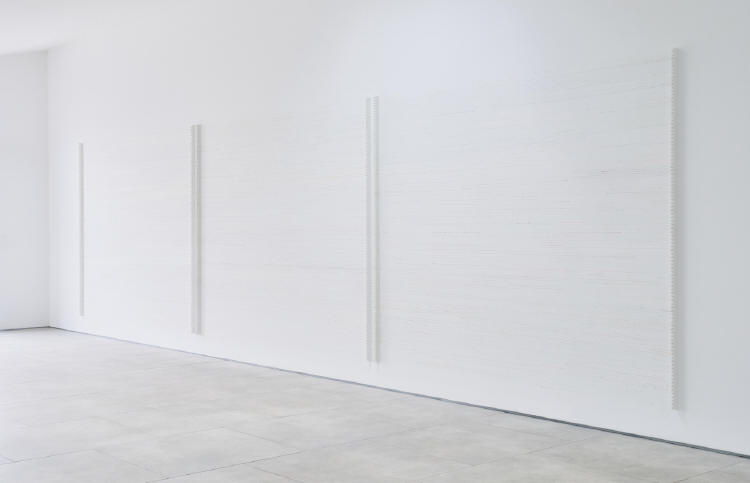
One Mile Line (2024)
What are you working on at the
moment?
At the moment we’re working on a project that has been developing quite
slowly over the past few years.
It began with us recovering small amounts of gold by hand from a stream
near our studio. The process itself was very simple, but demanding -
long days spent working the same stretch of water, gradually learning
how to read it. Over a period of nine weeks we recovered a target of ten
grams.
What interested us was the trajectory of the material, and the
associations it carries. Gold forms through extreme cosmic events -
supernovae and neutron star collisions - before becoming embedded in the
earth, and eventually appearing in a landscape like this. That long
chain of transformations, from astronomical to geological to human,
became central to the work.
We’re now working with scientists in the Department of Physics and
Astronomy at the University of Sussex to deposit that gold as a very
thin layer onto glass, using a process called sputtering.
The idea is to use that gold to produce a new work that will
eventually return to the same landscape from which the material was
sourced.
It’s still unfolding, but it feels like a project that’s allowing us to
bring together a number of strands in the work - material, time, and
place - while also opening up questions of scale that feel quite new to
us.
https://afmackie.com/
|